
Cybersecurity A Solid First Line of Defense
What is Cybersecurity?
At its core, cybersecurity is the practice of safeguarding computers, networks, applications, and sensitive data from unauthorized access, damage, or theft. It encompasses a wide range of protective measures, from firewalls and encryption to secure authentication methods and threat monitoring systems. For small businesses, implementing cybersecurity strategies can prevent costly breaches, protect customer information, and ensure compliance with data protection regulations. For larger corporations, it is an essential layer of defense against sophisticated cyberattacks that can disrupt operations, compromise intellectual property, and damage brand reputation. Cybersecurity is not just about technology; it also involves educating employees, setting strong policies, and continuously monitoring digital environments to mitigate risks.
Why Cybersecurity Isn’t as Easy as It Seems
Many people assume that cybersecurity is as simple as installing antivirus software or updating passwords occasionally. In reality, it is a constantly evolving field that requires vigilance and strategic planning. Hackers are continually developing new techniques, from phishing emails and ransomware to advanced malware and zero-day exploits, meaning defenses must adapt just as quickly. Organizations must manage a complex ecosystem that includes servers, endpoints, mobile devices, cloud platforms, and the Internet of Things (IoT), each with its own vulnerabilities. Additionally, human error remains one of the largest security risks—weak passwords, accidental data exposure, or falling for social engineering attacks can undermine even the most robust systems. Staying ahead in cybersecurity involves continuous updates, monitoring, threat intelligence, and a proactive approach to both technology and human behavior.
Businesses looking to streamline processes securely can benefit from digital content delivery bots that handle data efficiently while maintaining safety protocols.
Here are some reasons why cybersecurity can be complex:
- Constant Updates Hackers evolve, and so must your defenses. Software updates, patch management, and new security protocols are necessary to stay ahead.
-
- Human Error According to studies, over 90% of successful cyberattacks are due to human error. From weak passwords to falling for phishing scams, people often represent the weakest link.
- Vast Coverage Area Cybersecurity doesn’t just protect your computer; it involves securing servers, networks, mobile devices, IoT devices, and even virtual cloud infrastructures.
That said, for those who want their security simplified, tools like firewalls, password managers, and managed security services provide a good starting point.
The “Easy” Angle With Cybersecurity
There’s no doubt that combatting cyber threats requires a constant learning curve. However, many tools and services now simplify its execution for personal users and businesses alike. Automated tools like two-factor authentication (2FA) or security apps make basic security accessible to users without technical expertise.
For example, which is easier: turning on a two-factor authentication setting or programming a neural network to predict trends? This simplicity often positions cybersecurity as “easier” compared to AI for those unfamiliar with technology. Organizations integrating lead generation chatbots strategy can apply security measures to protect user interactions efficiently.
Artificial Intelligence Breaking New Boundaries
What is Artificial Intelligence?
Artificial intelligence refers to the capability of machines to perform tasks that would typically require human intelligence. Think of chatbots like ChatGPT, recommendation systems like Netflix, or autonomous vehicles. AI spans across numerous fields, including machine learning, robotics, and natural language processing.
Why AI is a Complex Beast
Building AI systems sounds exciting, but it comes with a steep learning curve. Here are major factors that make AI challenging to grasp:
- Learning Data and Algorithms Unlike cybersecurity, AI requires complex algorithms, coding, and large datasets. Resources like best tools to build artificial intelligence guide beginners in practical AI development.
- Bias in AI One of the biggest challenges in implementing AI is ensuring unbiased decision-making. Training datasets often reflect real-world inequalities, which can skew AI outcomes.
- Automation with Accuracy Developing systems that think and act intelligently often involves trial, error, and continuous iteration. Predicting outcomes, spotting errors, and retraining models are tedious but integral parts of AI development.
The “Easy” Angle With AI
AI systems like virtual assistants or auto-correct features are user-friendly. Once implemented, AI can save significant time and resources. However, creating AI requires specialized knowledge. Platforms such as building AI without writing a single line make AI development more accessible without deep programming expertise. Unlike deploying cybersecurity measures that often require following prescribed protocols, AI development demands a thorough understanding of both technology and human behavior.
For example, using an AI-powered app like Grammarly to check your grammar is easy, but creating the app is entirely different and requires specialized knowledge.
Comparing Cybersecurity and AI Which One is Easier?
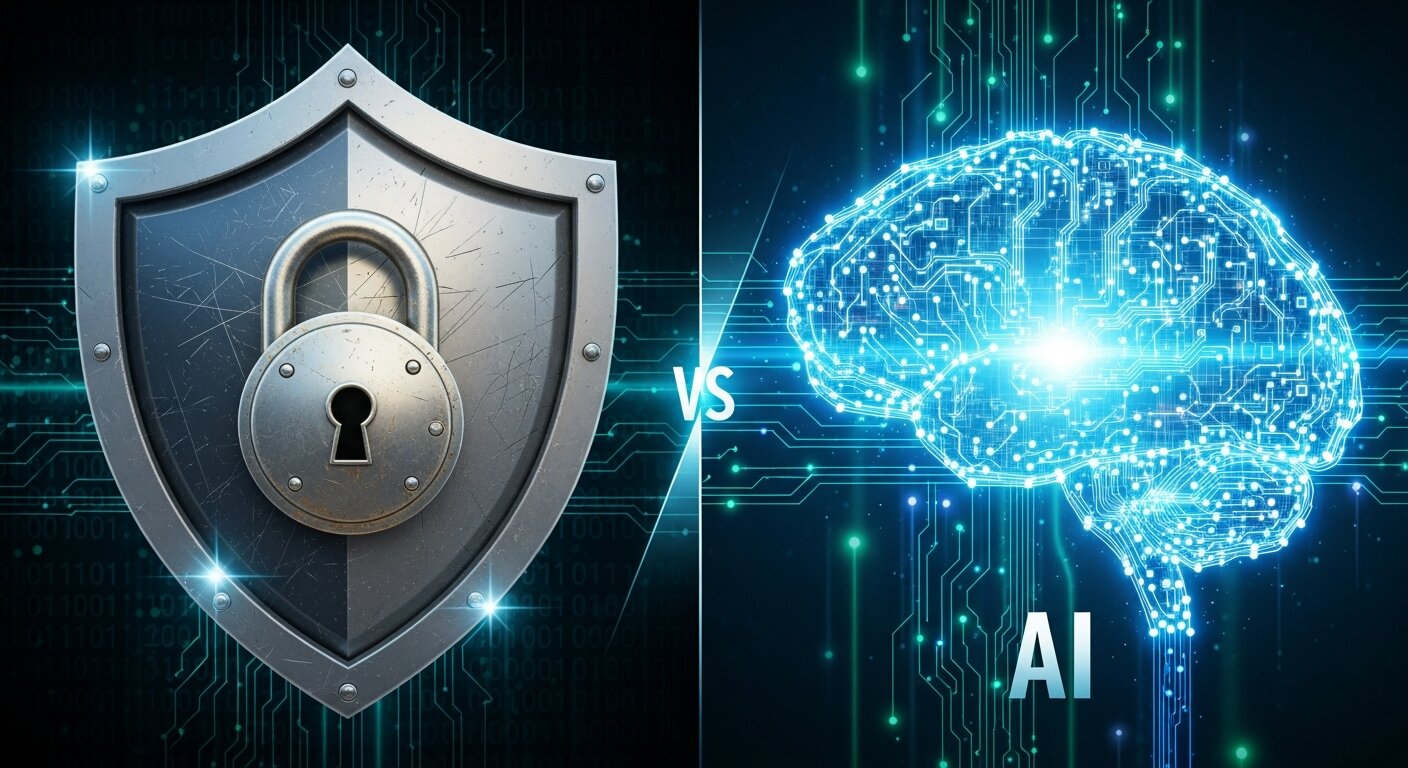
When debating whether cybersecurity or artificial intelligence is “easier,” a lot depends on your perspective and goals. Here’s a breakdown:
Learning Curve
For beginners, Easy Cybersecurity or Artificial Intelligence often depends on approachability. Cybersecurity has a structured learning path, while AI involves abstract concepts like neural networks and algorithms. Exploring what is programmable automation shows how AI and automation can complement security workflows. On the other hand, artificial intelligence requires understanding abstract concepts like machine learning algorithms, neural networks, probability, and statistics, which can make AI appear much more complex compared to cybersecurity.
Implementation
When considering Easy Cybersecurity or Artificial Intelligence, implementing basic cybersecurity measures is often simpler for beginners. Setting up antivirus software, two-factor authentication, or network monitoring can be achieved with clear instructions and minimal technical expertise. Conversely, developing AI systems—such as predictive models, chatbots, or recommendation engines—demands advanced programming skills, dataset management, and algorithm optimization. While enterprise cybersecurity systems can become complex, AI development usually involves more ongoing technical effort and iterative testing.
Adaptability
AI is designed to adapt automatically as it processes data, learning from patterns to improve performance over time. However, designing systems that adapt correctly is highly technical and requires deep expertise. In contrast, cybersecurity tools rely on updates, patches, and security protocols to stay effective against evolving threats. For most users, Easy Cybersecurity or Artificial Intelligence leans toward cybersecurity, as adaptability is largely handled by existing software and procedures rather than requiring extensive technical intervention.
Day-to-Day Impact
The daily applications of AI, from predictive analytics to automating customer service, can be powerful but require careful monitoring to avoid errors or biases. On the other hand, cybersecurity has immediate and tangible importance: neglecting it can lead to data breaches, financial losses, or reputational damage. Considering Easy Cybersecurity or Artificial Intelligence, cybersecurity is often more essential for everyone, while AI adoption is usually industry- or use-case-specific. Combining strong cybersecurity with AI solutions can maximize both security and innovation in any organization.
Why Not Both?
When deciding between Easy Cybersecurity or Artificial Intelligence, the question isn’t necessarily which is simpler—it’s which aligns best with your goals and needs. In reality, both fields complement each other and often work best together. AI tools, such as predictive analytics, anomaly detection, and behavior monitoring, are increasingly used to strengthen cybersecurity by identifying threats before they cause damage. At the same time, robust cybersecurity frameworks protect AI systems from being manipulated, ensuring data integrity and preventing malicious interference.
For businesses and individuals alike, combining cybersecurity measures with AI capabilities creates a powerful synergy. While AI enhances detection, automation, and efficiency, cybersecurity ensures that these advanced tools operate safely and reliably. Thinking in terms of Easy Cybersecurity or Artificial Intelligence allows organizations to start with manageable steps in cybersecurity while gradually integrating AI solutions, ultimately creating a secure and intelligent technology ecosystem.
Here’s an overlap example:
- AI is used to detect and mitigate threats by identifying unusual patterns in a system.
- Cybersecurity protects AI models from adversarial attacks aiming to exploit vulnerabilities.
What Should You Focus On?
For individuals:
- Prioritize learning the basics of cybersecurity to protect yourself from common online threats.
- Explore AI features in apps and platforms for day-to-day productivity improvements, such as smart email filters or photo tagging.
For businesses:
- A solid cybersecurity foundation is non-negotiable. Start with tools like firewalls, endpoint protection, and employee security training.
- Begin exploring AI solutions that are tailored to your industry. For instance, marketing teams might use AI for customer segmentation, while financial teams automate forecasting.
Final Thoughts on Cybersecurity and AI
Calling one “easier” depends entirely on your perspective and use case. Cybersecurity offers more structured approaches to protection, with fewer tools needed for beginners. On the other hand, AI, though immensely powerful, involves more abstract concepts that might take time to fully grasp.
Ultimately, both cybersecurity and AI are vital in today’s technology-driven world. Becoming familiar with both can open doors to innovation and safety, ensuring you’re ahead in a competitive landscape.
Interested in exploring how AI can transform your business? Try our free AI toolkit here and start unlocking possibilities today.
Frequently Asked Questions (FAQs)
Which is easier to learn: cybersecurity or artificial intelligence?
The answer depends on your perspective and background. Cybersecurity often follows structured rules and protocols, making it easier for beginners to implement basic protections. AI requires understanding algorithms, data models, and coding, which can be more complex. Hence, the question of Easy Cybersecurity or Artificial Intelligence is subjective and based on your learning style.
Can AI improve cybersecurity measures?
Absolutely. AI enhances cybersecurity by detecting threats in real time, predicting potential breaches, and automating responses. Integrating AI into security systems demonstrates how Easy Cybersecurity or Artificial Intelligence can work together to strengthen defenses.
Is cybersecurity necessary before implementing AI?
Yes. AI systems rely on data integrity and security. Without proper cybersecurity, AI models can be manipulated or exploited. Prioritizing cybersecurity ensures that your AI implementations are safe, reliable, and effective.
What skills are required to work with AI and cybersecurity together?
Working at the intersection of AI and cybersecurity requires understanding threat analysis, data security, programming, machine learning, and ethical considerations. Familiarity with both areas allows professionals to leverage Easy Cybersecurity or Artificial Intelligence solutions effectively.
Can small businesses use AI-driven cybersecurity tools?
Yes. Cloud-based AI security solutions are accessible to small businesses, providing predictive threat detection and automated monitoring without the need for a large IT team. This shows that Easy Cybersecurity or Artificial Intelligence solutions can scale across businesses of all sizes.
How do I decide whether to focus on cybersecurity or AI?
Focus on your career goals, interests, and the type of problems you enjoy solving. If you prefer structured, rule-based challenges, cybersecurity may feel easier. If you enjoy data, algorithms, and predictive modeling, AI may be more engaging. Considering Easy Cybersecurity or Artificial Intelligence together can also provide a hybrid approach for long-term growth.
How long does it take to get proficient in Easy Cybersecurity or Artificial Intelligence?
The time to proficiency depends on your background and learning approach. Basic cybersecurity skills can be learned in weeks, while advanced AI concepts often take months of study and practice. Combining both allows professionals to understand Easy Cybersecurity or Artificial Intelligence from a practical perspective.
Can Easy Cybersecurity or Artificial Intelligence be used together in small businesses?
Yes. Small businesses can implement AI-powered security tools to monitor networks, detect threats, and automate responses. Leveraging both demonstrates how Easy Cybersecurity or Artificial Intelligence solutions can improve protection and operational efficiency.
Are there beginner-friendly tools for Easy Cybersecurity or Artificial Intelligence?
Absolutely. Tools like password managers, antivirus software, and 2FA simplify cybersecurity, while AI platforms such as chatbots or recommendation engines are designed for easy integration. These resources make Easy Cybersecurity or Artificial Intelligence more accessible for beginners.
Which career path is more suitable: Easy Cybersecurity or Artificial Intelligence?
It depends on your interests. Cybersecurity suits those who enjoy structured problem-solving and risk management, while AI appeals to those fascinated by data, algorithms, and automation. Exploring both helps you make an informed decision about Easy Cybersecurity or Artificial Intelligence careers.