

Building a successful marketing strategy isn’t about guessing; it’s about precision. By mastering how to create a content marketing plan rooted in accurate data entry, you transform raw information into a roadmap for revenue and growth.
This comprehensive guide details how to create a content marketing plan using data entry as your strategic backbone. We cover analyzing target audiences, performing deep content audits, defining SMART goals, brainstorming data-backed ideas, optimizing for SEO, and measuring performance. You will learn to leverage tools like Google Analytics and SEMrush to organize data effectively.
Why Data Entry is the Missing Link in Content Strategy
When marketers ask how to create a content marketing plan, they often focus on creativity—viral videos, witty tweets, and engaging blog posts. While creativity is the engine, data is the fuel. Without a structured way to collect, organize, and analyze information, your creative efforts are shots in the dark.
This is where data entry becomes a superpower. It is not just about typing numbers into a spreadsheet; it is the systematic process of recording intelligence. By treating data entry as a core component of your strategy, you move from “I think this will work” to “I know this will work because the data proves it.”
Whether you are performing manual data entry to track competitor headlines or using Robotic Process Automation for Data Entry to scrape thousands of keywords, the goal remains the same: structure chaos into clarity. This guide will show you exactly how to create a content marketing plan that relies on this structured approach.
Analyze Your Target Audience

The first step in learning how to create a content marketing plan is understanding who you are talking to. However, vague personas like “Marketing Mary” are no longer enough. You need granular data, and you need a system to record it.
The Role of Data Collection
You cannot create content that converts if you don’t know what keeps your audience up at night. You need to gather quantitative (numbers) and qualitative (feelings) data.
Sources for Audience Data:
- Google Analytics: This tool provides the “who” and “where.” Look at demographics, location, and device usage.
- Social Media Insights: Platforms like LinkedIn and Instagram tell you what formats your audience prefers.
- Customer Surveys: Direct feedback is gold. Ask them what they want to read.
- Sales Team Feedback: Your sales team talks to prospects daily. They know the exact objections customers have.
Data Entry Action: The Audience Persona Database
To truly master how to create a content marketing plan, you must organize this research. Create a master spreadsheet or use a CRM.
Columns to include in your data entry:
- Demographic Segment: Age, Location, Job Title.
- Pain Points: Specific problems they face (e.g., “struggling with manual data entry”).
- Goals: What they want to achieve (e.g., “automate workflows”).
- Preferred Content Formats: Do they like video, long-form blogs, or whitepapers?
- Information Sources: Where do they hang out? (Reddit, LinkedIn, Industry Forums).
Leveraging Segmentation
Once you have entered this data, you can segment your audience. You might discover that CEOs prefer quick summaries (like the one at the start of this article), while practitioners want detailed “how-to” guides. A robust plan addresses both by tailoring content types to specific data segments.
For example, if you are selling Data Entry Automation software, your content for the CEO discusses ROI and labor savings. Your content for the IT manager discusses API for Real-Time Data Sync and integration capabilities. You only know this distinction because you took the time to enter and analyze the audience data.
Perform a Content Audit

You cannot plan where you are going if you don’t know where you are. Step two of how to create a content marketing plan is performing a rigorous content audit. This is often the most data-entry-intensive part of the process, but it yields the highest ROI.
Structuring Your Audit
A content audit involves listing every piece of content you have ever created and evaluating its performance. This sounds daunting, but with the right data entry workflow, it is manageable.
Tools to help:
- SEMrush / Ahrefs: essential for pulling backlink and keyword data.
- Google Search Console: For click-through rates (CTR) and impressions.
- Screaming Frog: Great for crawling your site to find every URL.
The Content Inventory Spreadsheet
Create a “Content Audit” spreadsheet. This will be your command center. You will populate this sheet with data to make informed decisions about what to keep, update, or delete.
Key Data Points to Enter:
- URL: The link to the content.
- Content Title: The H1 tag.
- Target Keyword: The primary phrase the content is trying to rank for.
- Traffic (Last 90 Days): How many people visited?
- Bounce Rate: Did they leave immediately?
- Backlinks: How many other sites link to this page?
- Conversion Rate: Did this content lead to a sale or lead?
- Action Item: (Keep, Update, Delete, Consolidate).
Analyzing the Data
Once your data entry is complete, look for patterns.
- High Traffic, Low Conversion: The topic is good, but the call-to-action (CTA) is weak. Action: Optimize conversion path.
- Low Traffic, High Conversion: The content is a sales machine, but nobody sees it. Action: Promote heavily or improve SEO.
- Low Traffic, Low Conversion: Dead weight. Action: Delete or redirect.
This audit prevents you from wasting time creating content that already exists or doesn’t work. It is a critical step in how to create a content marketing plan that is efficient and effective.
Define SMART Goals
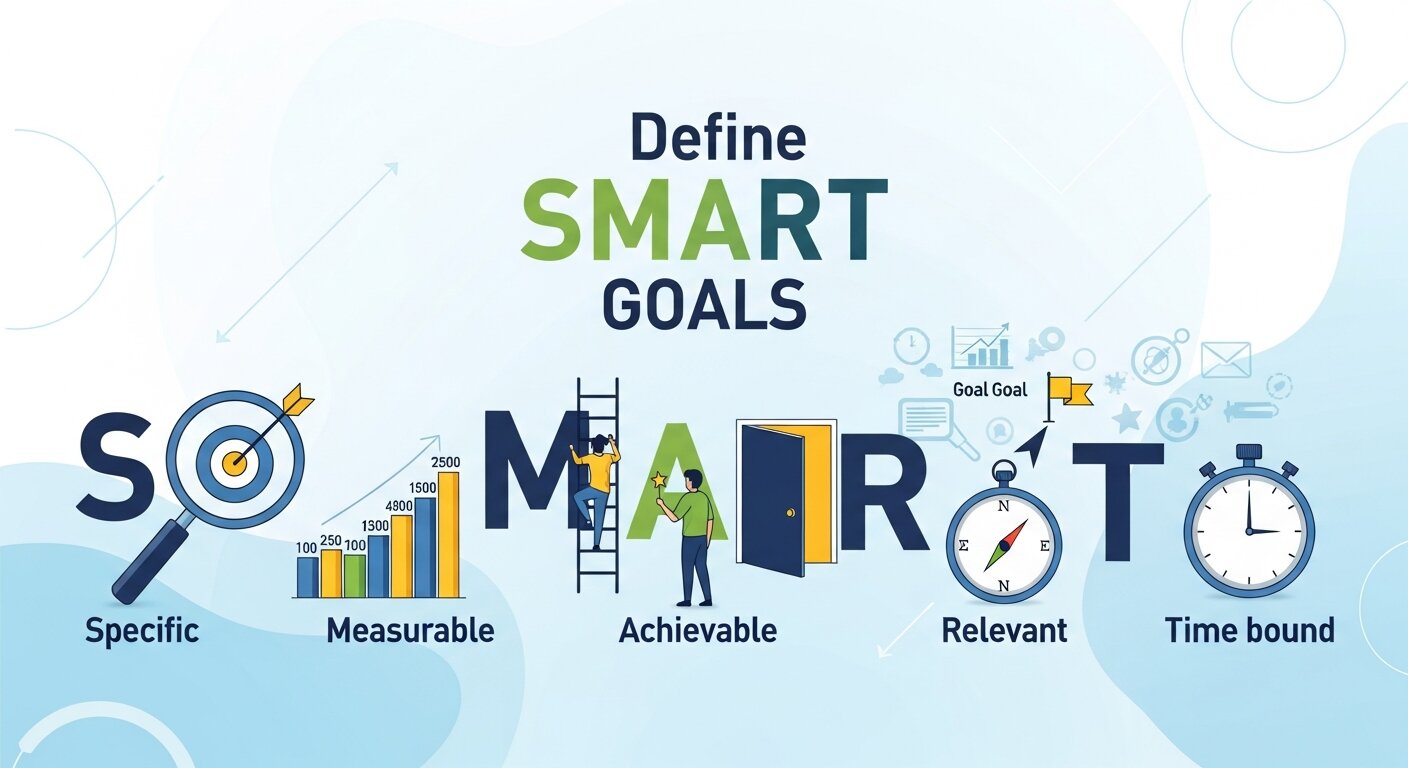
“Getting more traffic” is not a plan; it is a wish. To understand how to create a content marketing plan that executives respect, you need SMART goals. These goals must be directly tied to the data you collected in steps 1 and 2.
The SMART Framework
- Specific: detailed and clear.
- Measurable: quantifiable via data.
- Achievable: realistic based on your audit.
- Relevant: aligns with business objectives.
- Time-bound: has a deadline.
Connecting Data to Goals
Your goals should dictate your data entry requirements moving forward. If your goal is lead generation, you must track form fills. If your goal is brand awareness, you must track impressions and share of voice.
Examples of SMART Goals in a Content Plan:
- Traffic: “Increase organic blog traffic by 25% (from 10k to 12.5k visits) within 6 months by publishing 4 SEO-optimized articles per week.”
- Leads: “Generate 50 marketing qualified leads (MQLs) per month through the ‘Ultimate Guide to CRM Data Management’ ebook download by Q3.”
- Engagement: “Improve average time on page for ‘How-To’ articles from 2 minutes to 4 minutes by embedding video content by the end of the year.”
The Goal Tracking Dashboard
You need a place to enter progress data weekly or monthly. Create a simple “Goal Tracking” tab in your strategy spreadsheet.
|
Goal Metric |
Baseline |
Target |
Current Month |
Status |
|---|---|---|---|---|
|
Organic Traffic |
5,000 |
8,000 |
6,200 |
On Track |
|
Newsletter Signups |
100 |
250 |
110 |
At Risk |
|
Backlinks Generated |
15 |
50 |
22 |
On Track |
By regularly entering this data, you can spot trends early. If you see “Newsletter Signups” falling behind, you can adjust your strategy immediately—perhaps by adding a pop-up or changing the lead magnet. This agility is the hallmark of knowing how to create a content marketing plan that works.
Brainstorm Content Ideas Backed by Data
The “brainstorming” phase is where many marketers go wrong. They sit in a room and throw ideas at a whiteboard based on gut instinct. When you know how to create a content marketing plan correctly, you use data to validate ideas before you write a single word.
Keyword Research and Intent
Keyword research is essentially data entry of user intent. You are researching what people type into search engines and recording that data to guide your topics.
Tools for Research:
- SEMrush / Ahrefs: For keyword volume and difficulty.
- AnswerThePublic: For finding questions people ask.
- Google Trends: For identifying seasonality.
The Content Roadmap Spreadsheet
As you research, you shouldn’t just look at keywords; you should catalogue them. Create a “Content Ideas” database.
Data to Enter:
- Topic Idea: The broad subject (e.g., “Data Entry Automation”).
- Focus Keyword: The specific search term (e.g., “How to Automate Data Entry in Excel”).
- Search Volume: Monthly searches.
- Keyword Difficulty (KD): How hard is it to rank?
- User Intent: Informational, Transactional, or Navigational?
- Funnel Stage: Top (Awareness), Middle (Consideration), or Bottom (Decision).
Using Gap Analysis
Look at your competitors. Enter their top-performing pages into your spreadsheet alongside your own. Where are the gaps?
- Do they have a guide on “How to Create a Data Entry Form in Excel” and you don’t?
- Is their guide outdated?
- Can you create something 10x better?
Semantic Relevance and LSI Keywords
When planning your content, don’t just pick one keyword. Use Latent Semantic Indexing (LSI) keywords to build context. If you are writing about “Automated Data Entry,” you should also log related terms like “OCR technology,” “workflow automation,” and “database management” in your planner. This ensures your writers cover the topic comprehensively, which Google rewards.
Optimize Content for Performance
You have planned the content; now you must ensure it performs. Optimization is not an afterthought; it is a data-driven process that happens during creation and immediately after publishing.
SEO Data Points
Understanding how to create a content marketing plan involves creating a checklist of SEO elements that must be verified for every post.
Optimization Checklist (Data Entry Fields):
- Title Tag: Does it include the keyword? Is it under 60 characters?
- Meta Description: Is it compelling? Under 155 characters?
- H1/H2/H3 Structure: Are headers used correctly to break up text?
- Keyword Density: Does the focus keyword “how to create a content marketing plan” appear naturally (around 1-3%)?
- Internal Links: Are you linking to at least 3 other relevant pages on your site?
- External Links: Are you citing high-authority sources like Wikipedia or industry studies?
A/B Testing Data
Optimization continues after publication. You should run A/B tests on headlines, featured images, and CTAs.
Example:
- Version A Headline: “Guide to Content Marketing Plans”
- Version B Headline: “How to Create a Content Marketing Plan in 6 Steps”
Enter the Click-Through Rate (CTR) data for both versions into your tracker. If Version B gets a 4% CTR and Version A gets 2%, you have a winner. You then roll out that insight across other posts. This systematic data entry allows you to scientifically improve your content’s performance over time.
Optimization for Different Platforms
Remember that optimization isn’t just for Google.
- YouTube: Optimize for watch time and CTR. Use tags like “How to become an affiliate marketer on YouTube” if relevant to your niche.
- Social Media: Optimize for engagement. Use trending hashtags found via data research.
Measure Performance and Adjust
The final, and perhaps most crucial, step in learning how to create a content marketing plan is measurement. A plan is a living document. It must evolve based on real-world data.
The Feedback Loop
You need a strict schedule for reviewing data.
- Weekly: Check social engagement and traffic spikes.
- Monthly: deep dive into lead generation, keyword rankings, and goal progress.
- Quarterly: Comprehensive audit of strategy alignment.
Key Performance Indicators (KPIs) to Track
You must enter specific metrics into your “Master KPI Dashboard” to see the health of your strategy.
- Consumption Metrics:
-
- Pageviews
- Unique Visitors
- Average Time on Page
- Retention Metrics:
-
- Bounce Rate
- Pages per Session
- Returning Visitor Rate
- Engagement Metrics:
-
- Social Shares
- Comments
- “Likes”
- Conversion Metrics:
-
- Click-Through Rate (CTR) on CTAs
- Form Submissions (Leads)
- Sales Revenue Attribution
Interpreting the Data for Adjustment
Data entry is useless without analysis.
- Scenario A: You see that blog posts about “Excel Automate Data Entry” have a high bounce rate.
-
- Adjustment: The content might be too complex or too simple. Add a video tutorial or downloadable template to keep users engaged.
- Scenario B: Your article on “What Is Artificial Intelligence?” brings in massive traffic but zero leads.
-
- Adjustment: The traffic is too top-of-funnel. Add a “Next Step” CTA guiding them to a more specific article like “Best Tools to Build Artificial Intelligence” to move them down the funnel.
The Cycle of Improvement
By consistently entering performance data, you create a historical record of success. You stop asking “What should we write?” and start saying “The data shows our audience loves guides on Marketing Automation, so let’s double down on that topic.” This is the ultimate goal of learning how to create a content marketing plan—creating a self-sustaining engine of growth.
Tools for Data-Driven Content Planning
To execute this plan effectively, you need the right tech stack. Here is a breakdown of essential tools and how they facilitate the data entry required for your plan.
1. Google Analytics (GA4)
Role: The source of truth for website traffic.
Data to Extract: User behavior flow, conversion paths, and demographic data.
Best Practice: Set up “Events” to track specific interactions like button clicks or video plays.
2. SEMrush or Ahrefs
Role: Competitive intelligence and keyword research.
Data to Extract: Keyword difficulty, backlink profiles of competitors, and content gaps.
Best Practice: Use the “Keyword Magic Tool” in SEMrush to find long-tail variations of “how to create a content marketing plan” to target niche queries.
3. CRM (HubSpot, Salesforce, Zoho)
Role: Connecting content to revenue.
Data to Extract: Which content pieces did a lead view before becoming a customer?
Best Practice: Ensure your CRM is tagging leads based on the content they downloaded. This proves ROI.
4. Project Management (Trello, Asana, Monday.com)
Role: Managing the workflow.
Data to Extract: Production time, publication consistency, and team bandwidth.
Best Practice: Use these tools to maintain your Editorial Calendar.
5. Automation Tools (Zapier, UiPath)
Role: Reducing manual data entry.
Data Action: Automatically send lead data from a Facebook Ad directly to your CRM and Google Sheet.
Best Practice: Automate the repetitive tasks so your team can focus on strategy and creation.
Advanced Strategy: Using Automation in Your Plan
As you scale, manual data entry becomes a bottleneck. Sophisticated marketers use automation to maintain their plans.
Robotic Process Automation (RPA):
RPA can handle high-volume data tasks. For example, you can use RPA bots to scrape competitor pricing or content headlines daily and enter them into your tracking sheet. This gives you real-time market awareness without lifting a finger.
Automated Reporting:
Instead of manually copying numbers from Google Analytics to Excel every month, use connectors like Looker Studio (formerly Google Data Studio). These tools pull data automatically, visualizing your KPIs in real-time dashboards. This ensures your knowledge of how to create a content marketing plan is always supported by up-to-the-minute data.
AI and Content Planning:
Artificial Intelligence is revolutionizing this space. Tools can now predict which topics will trend. By feeding historical performance data into an AI model, you can get suggestions for titles, keywords, and even outlines that have a high statistical probability of success.
Conclusion
Mastering how to create a content marketing plan requires a shift in mindset. It is not just about writing; it is about engineering success through data. By diligently analyzing your audience, auditing your assets, setting SMART goals, and continuously measuring performance via structured data entry, you build a marketing engine that is predictable, scalable, and highly effective.
Start today. Open a spreadsheet. Begin entering the data that matters. The difference between a good marketer and a great one is often found in the rows and columns of their plan.
FAQs:
1. What is the first step in creating a content marketing plan?
The absolute first step in learning how to create a content marketing plan is analyzing your target audience. Before you brainstorm ideas or write a single word, you must understand who you are trying to reach. This involves collecting demographic data, understanding their pain points, and identifying where they consume content online. Without this foundational data, your plan will lack direction and likely fail to convert.
2. How often should I update my content marketing plan?
Your content marketing plan should be a living document. While your high-level strategy and annual goals might be set once a year, you should review your performance data monthly and adjust your tactics accordingly. A comprehensive audit, where you revisit your audience personas and major content themes, should happen at least quarterly to ensure you remain aligned with market trends and business objectives.
3. Why is data entry important for content marketing?
Data entry is the bridge between raw information and actionable strategy. It allows you to organize vast amounts of data—from keyword research and competitor analysis to performance metrics—into a structured format that can be analyzed. Systematic data entry ensures that decisions are based on historical facts and trends rather than assumptions, leading to a higher ROI and more predictable results.
4. What are SMART goals in content marketing?
SMART stands for Specific, Measurable, Achievable, Relevant, and Time-bound. In the context of how to create a content marketing plan, a SMART goal would be: “Increase organic blog traffic by 20% in the next 6 months by publishing three SEO-optimized articles weekly.” This is far superior to a vague goal like “get more traffic,” because it provides a clear target and a deadline, making it easier to track progress.
5. How do I perform a content audit?
To perform a content audit, list all your existing content assets (blogs, videos, ebooks) in a spreadsheet. Then, using tools like Google Analytics, enter data for each asset regarding its performance (page views, bounce rate, conversions). Analyze this data to categorize content into “Keep,” “Update,” or “Delete.” This process reveals what is working, what is outdated, and where you have opportunities to improve SEO or conversion rates.
6. What tools are best for content marketing planning?
Several tools are essential for a data-driven plan. Google Analytics is critical for tracking website performance. SEMrush or Ahrefs are industry standards for keyword research and competitor analysis. Project management tools like Trello or Asana help manage the editorial calendar. Finally, spreadsheets (Excel or Google Sheets) remain invaluable for customized data entry and tracking specific KPIs relevant to your business.
7. How do I choose the right keywords for my plan?
Choosing the right keywords involves balancing search volume with ranking difficulty and user intent. Use tools to find keywords that your target audience is searching for. Look for a mix of “head terms” (high volume, competitive) and “long-tail keywords” (lower volume, highly specific, higher conversion intent). Crucially, ensure the intent behind the keyword matches your content—if someone searches “buy running shoes,” don’t serve them a history of shoelaces.
8. What is the difference between content strategy and content marketing?
Content strategy is the “why” and “how”—it is the high-level planning, management, and governance of content. It involves the data entry, auditing, and persona development discussed in this guide. Content marketing is the “what” and “where”—it is the execution of that strategy through the creation and distribution of valuable material to attract and engage an audience. You need a solid strategy to do effective marketing.
9. How can I measure the ROI of my content marketing plan?
Measuring ROI requires tracking conversions, not just traffic. You need to know how much revenue a piece of content generated compared to how much it cost to produce. Setup conversion tracking in Google Analytics for goals like form fills, newsletter signups, or purchases. Assign a monetary value to these actions. By subtracting the cost of content production and distribution from the value generated, you can calculate your ROI.
10. Can I automate parts of my content marketing plan?
Yes, automation is highly effective for data entry and distribution. You can use tools to automatically post content to social media, send email sequences to new leads, and even scrape competitor data for your research spreadsheets. However, the creative aspects—writing, strategy, and relationship building—still require a human touch. Automation should support your strategy, not replace the genuine connection with your audience.