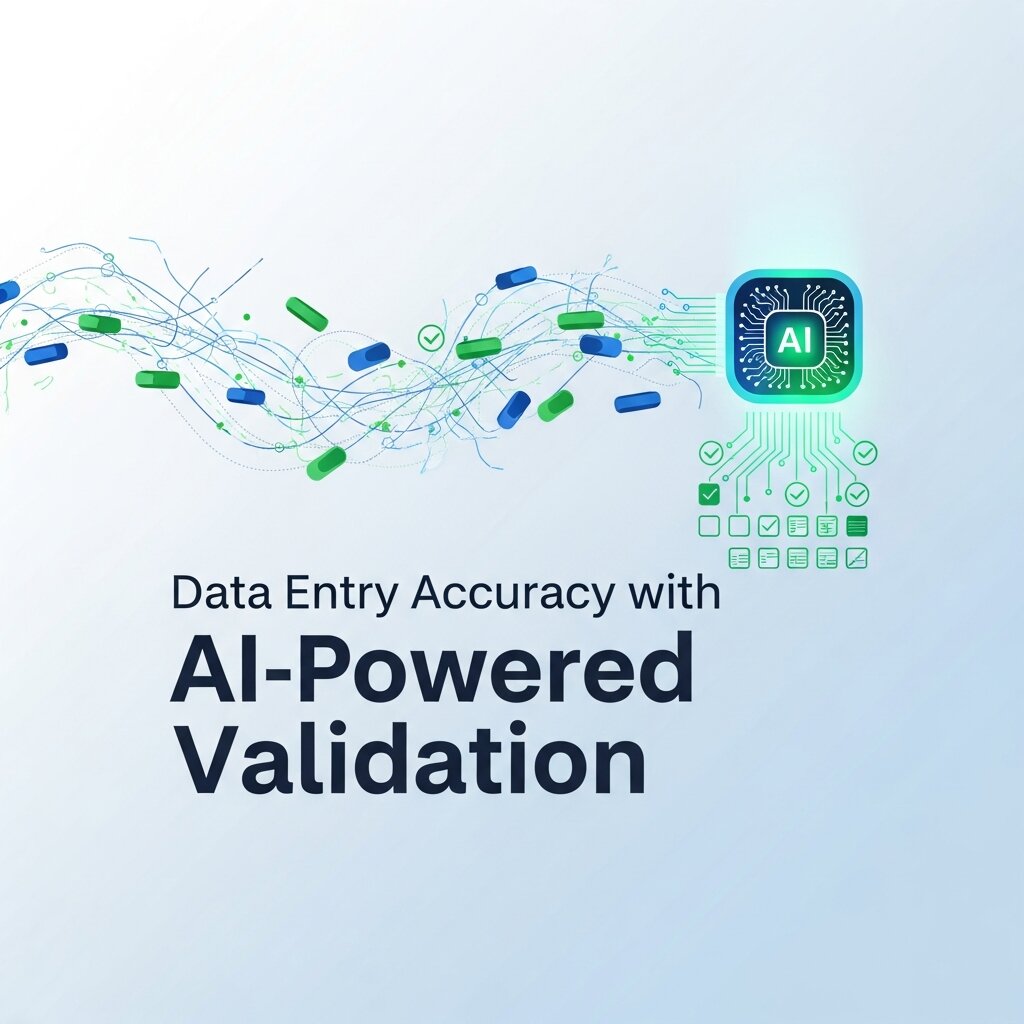
In today’s data-driven landscape, businesses depend on precise information for decision-making and optimizing processes. With massive volumes of records pouring in daily, even minor mistakes can trigger inefficiencies, inaccurate reporting, or compliance issues. Manual input processes, while familiar, often falter under pressure, leading to typographical slips, inconsistent formatting, and overlooked duplicates. Embracing AI-powered validation transforms this scenario by embedding intelligent checks directly into data capture workflows.
By integrating automated validation, teams free up time from repetitive manual reviews and focus on strategic initiatives. Organizations currently harness this technology to enforce uniform standards across departments and reduce latency in reporting cycles. In today’s digital landscape, trusted data becomes a competitive asset, enabling faster response to market shifts and more reliable forecasts. This guide examines key factors that make data accuracy paramount, explores common pitfalls in traditional entry methods, and delves into cutting-edge AI techniques for validation. We will also outline practical strategies for successful adoption, supported by insights from leading research institutions. Whether you are a data governance professional, IT manager, or operations leader, this overview provides actionable recommendations to elevate your data entry practices using AI-powered validation. By the end of this article, you will understand how to implement robust validation strategies that align with evolving business rules and maintain high integrity of datasets throughout your organization.
Why Data Accuracy Matters in Today’s Business Operations
Accurate data is the foundation for sound decisions, efficient workflows, and regulatory compliance. This year (2026), enterprises process unprecedented amounts of customer records, financial transactions, and operational metrics. Inaccurate or incomplete entries can ripple through systems, causing flawed analytics, misaligned budgets, and customer dissatisfaction. For example, a minor miscode in a billing field may generate incorrect invoices, leading to payment delays and additional support costs. By prioritizing data quality, organizations safeguard their reputation and strengthen stakeholder trust.
Moreover, key performance indicators (KPIs) depend on data integrity. Marketing teams analyze campaign metrics to allocate budgets, while supply chain managers forecast demand based on inventory records. If underlying data contains errors such as duplicated rows or invalid addresses, insights become skewed. This can hinder strategic planning and expose operations to unnecessary risks. An accurate dataset ensures that dashboards, reports, and alerts reflect true conditions, empowering teams to respond swiftly to emerging opportunities or challenges.
Another critical aspect is regulatory adherence. Industries such as healthcare, finance, and government face stringent data governance mandates. Compliance requirements often stipulate audit trails, field validations, and tamper-evident logs. In this environment, manual verification may fall short of meeting audit standards, increasing the likelihood of penalties and reputational damage. Advanced validation mechanisms, including AI-powered validation, provide automated compliance checks, reducing manual burden while maintaining robust oversight.
In today’s digital landscape, customer experience relies on frictionless interactions. Whether onboarding new clients or processing service requests, accurate data entry speeds up workflows and minimizes the need for manual corrections. A seamless user experience fosters loyalty and drives competitive differentiation. Conversely, visible errors—such as mismatched names or incorrect shipment details—can erode confidence and prompt clients to seek alternatives.
Strategic initiatives, such as product launches and mergers, also depend on consolidated datasets. Inaccurate records during system integration can lead to duplicated accounts or mismatched transaction histories, complicating due diligence and prolonging project timelines. AI-powered validation ensures that data from disparate sources undergoes consistent scrutiny, aligning formats and resolving conflicts before integration. This proactive approach reduces risk during critical business milestones and enhances overall agility.
Finally, cost savings represent a compelling driver. Manual error correction consumes significant staff hours, often diverting resources from high-value projects. According to a study by the National Institute of Standards and Technology (NIST), poor data quality costs the U.S. economy billions of dollars annually. By adopting AI-assisted validation, companies can detect errors at the point of entry, minimize rework, and accelerate processing times. The return on investment becomes clear as error rates drop and teams redirect efforts toward innovation and growth.
Challenges of Traditional Data Entry for Modern Enterprises
While data entry remains essential, manual and rule-based approaches reveal significant weaknesses as organizations scale. When staff members manually record information, fatigue, distractions, and varying levels of training contribute to frequent mistakes. Standard validation rules—such as mandatory field checks or simple format masks—often miss logical inconsistencies, like an address not matching regional postal codes or free-text responses that contradict other fields. These limitations slow down processing and reduce confidence in the underlying datasets.
- Human Error: Even with training and periodic audits, typos, omissions, and transposed characters slip through. Overreliance on human review increases labor costs without guaranteeing consistency.
- Scalability Constraints: As data volumes expand, manual validation becomes a bottleneck. Meeting tight deadlines forces teams to choose between speed and accuracy, often compromising one for the other.
- Inconsistent Standards: Without centralized enforcement, departments apply rules differently. One team may accept abbreviations while another insists on full spellings, resulting in fragmented records and integration issues.
- Limited Contextual Analysis: Traditional systems verify syntax but lack semantic understanding. Complex fields—like product descriptions or clinical notes—remain largely unchecked for meaning, reducing overall reliability.
- Delayed Feedback: Errors caught downstream can require back-and-forth queries, extending resolution cycles and frustrating both staff and customers.
These challenges intensify in environments processing thousands of entries per day. Delayed detection can cascade into larger issues, such as inaccurate financial reports or shipments to wrong addresses. Moreover, error-prone datasets hamper cross-functional collaboration, as teams distrust metrics and hesitate to act on automated insights.
Adopting specialized validation software can mitigate some of these problems, but rule-based engines still struggle to handle evolving business vocabulary and exceptions. Without continuous updates, these tools generate false positives or miss critical anomalies, leading to alert fatigue and eventual disregard for flags. In this context, AI-powered validation offers a more dynamic solution, capable of learning from patterns and adapting to changing data landscapes.
In today’s fast-moving markets, organizations cannot afford lengthy error-resolution processes. Customer satisfaction, compliance deadlines, and operational benchmarks demand agility. Shifting from static validation schedules to continuous, intelligent oversight using AI-powered validation helps teams maintain momentum without sacrificing trust in their data assets.
Advancements in Machine Learning and NLP for Data Validation
Modern data validation leverages machine learning models trained on historical records to classify inputs as valid or suspicious. These classification algorithms identify patterns in numeric fields, categorical entries, and free-text annotations by learning from labeled examples. Over time, models refine their criteria for normal versus abnormal values, reducing reliance on rigid rule sets. According to research from Harvard University, adaptive classification significantly improves both precision and recall in flagging erroneous entries compared to static filters.
Natural language processing (NLP) expands validation beyond structured fields. By employing tokenization, part-of-speech tagging, and semantic analysis, NLP engines interpret meaning in descriptions, comments, and customer feedback. This capability allows systems to catch contextual mismatches—such as a product review mentioning temperature-sensitive items shipped in hot regions—prompting validation checks specific to the domain. These algorithms continuously evolve as they process new vocabulary and user corrections, ensuring ongoing relevance.
Anomaly detection techniques draw from statistical methods and clustering algorithms to pinpoint outliers that deviate from expected ranges or patterns. Whether surges in transaction amounts or unusual shipment destinations, AI-driven anomaly detection alerts data stewards to potential errors before they escalate. Combined with visualization tools, teams gain immediate insights into emerging trends and can drill down into individual records for rapid remediation.
Fuzzy matching introduces tolerance for minor discrepancies, using string similarity metrics such as Levenshtein distance or cosine similarity to identify near-duplicate records. This approach proves invaluable when merging datasets from multiple sources, where spelling variations and formatting differences often obstruct straightforward joins. By detecting entities that likely refer to the same object or person, fuzzy matching streamlines deduplication and enhances master data management.
Currently, integrating these techniques into unified validation pipelines forms an end-to-end solution. Machine learning classification, NLP, anomaly detection, and fuzzy matching work in concert, providing layered defenses against errors. As AI-powered validation becomes more accessible through open-source frameworks and cloud services, organizations of all sizes can adopt sophisticated data quality measures with minimal infrastructure investment.
Effective AI-Powered Validation Techniques and Strategies
Implementing AI-powered validation requires an understanding of core techniques. Below are four strategies that deliver high impact in today’s environments.
Pattern Recognition and Auto-Correction
AI models trained on reference datasets detect common patterns such as phone number formats, postal codes, and part numbers. By comparing input entries against authoritative sources, the system can automatically correct mismatches. For example, if a ZIP code does not align with the specified city, the validation engine cross-references an external postal database and proposes a correction. This reduces manual lookups and ensures uniform formatting across records. Over time, the model refines its auto-correction logic based on user acceptance of suggestions, gradually minimizing the need for human review.
Contextual Field Validation
Contextual validation uses NLP to assess whether free-text inputs align with business rules. For instance, a description field mentioning “overnight shipment” triggers a check on delivery options to confirm availability. Similarly, product attributes like “large widget” are validated against size specifications. This semantic approach goes beyond checking for null values or fixed patterns by evaluating meaning and intent. Contextual checks help catch inconsistencies that rule-based systems typically overlook, ensuring that interrelated fields maintain logical coherence.
Real-Time Feedback Loop
Inserting validation services directly into data entry interfaces offers immediate user feedback. As a user types or pastes information, the system highlights issues—such as misspelled names or out-of-range values—and suggests fixes before form submission. This proactive approach prevents error accumulation, reducing downstream correction cycles. Real-time feedback also educates operators by illustrating proper data formats and contextual expectations. By resolving mistakes on the spot, organizations accelerate workflows and minimize frustration.
Adaptive Learning
Adaptive learning drives continuous improvement in validation accuracy. Machine learning models consume feedback on accepted or rejected suggestions, adjusting decision thresholds to better align with evolving business requirements. For example, if users frequently override a specific validation rule, the model incorporates this behavior to reduce false positives. Conversely, repeated rejections of inaccuracies strengthen anomaly detection parameters. Adaptive feedback loops ensure that AI-powered validation stays current with changing data patterns, vocabulary, and organizational processes.
Best Practices for Implementing AI-Driven Data Entry Validation
Successful adoption of AI-powered validation depends on a strategic approach that balances technical capabilities with organizational change management. Before rolling out, involve stakeholders from IT, operations, and data governance to align objectives and define actionable success metrics.
- Define Clear Objectives: Identify the most costly or frequent error types and set quantifiable goals for reduction. Prioritize validation features based on business impact—such as improving invoice accuracy or safeguarding regulatory compliance.
- Curate High-Quality Training Data: Assemble representative datasets that reflect real-world scenarios. Cleanse inputs to remove legacy errors and biases before training machine learning models. Refer to guidelines from NIST for data quality frameworks.
- Establish Feedback Channels: Provide user interfaces for staff to accept, reject, or annotate AI suggestions. Capture this feedback to refine model parameters and reduce false positives over time.
- Monitor and Audit Performance: Track validation metrics such as error rejection rates, user override frequency, and processing times. Conduct periodic audits to detect model drift and update training data as business rules evolve.
- Scale Incrementally: Begin with pilot projects targeting high-priority workflows. Evaluate results, gather lessons learned, and expand to additional systems. This phased approach minimizes risk and cultivates user confidence.
By following these practices, organizations ensure that AI-powered validation delivers measurable improvements in data quality and operational efficiency. Engaging end users, maintaining transparent performance tracking, and nurturing collaborative governance pave the way for sustainable success. Organizations that prioritize continuous learning and transparent communication establish a culture of data excellence. In today’s digital landscape, embedding AI-powered validation fosters trust and unlocks strategic insights. By gradually extending coverage to additional domains—such as customer service interactions or IoT sensor readings—teams can build on early successes and refine processes. Ultimately, integrating automated oversight transforms raw entries into reliable assets, powering smarter decisions and driving growth.
Frequently Asked Questions
What is AI-powered data validation?
AI-powered data validation uses machine learning and natural language processing to automatically check the accuracy, consistency, and completeness of data entries in real time. It identifies anomalies, suggests corrections, and adapts to evolving data patterns.
How does AI validation differ from rule-based validation?
Rule-based validation relies on static checks and predefined patterns, while AI-powered validation learns from data, incorporates contextual understanding, and adapts over time. This makes AI more effective at catching semantic errors and reducing false positives.
Can AI-powered validation integrate with existing data entry systems?
Yes. Most AI validation solutions offer APIs or plugins that seamlessly integrate with web forms, CRMs, ERP systems, and custom applications, providing real-time feedback without major infrastructure changes.
What are the key benefits of real-time validation?
Real-time validation catches errors at the point of entry, reduces downstream correction costs, accelerates workflows, and improves user experience by providing instant feedback and suggestions.
How do organizations measure the success of AI-powered validation?
Success is measured by reductions in error rates, decreased manual correction efforts, faster processing times, and improved compliance metrics. Tracking user override frequencies and model accuracy over time also helps gauge effectiveness.
Conclusion
As we navigate a world where data volume, velocity, and variety are increasing exponentially, ensuring entry accuracy becomes paramount. This year (2026), organizations that leverage AI-powered validation gain a decisive advantage by catching errors at the source, accelerating processing times, and reducing operational risk. By combining machine learning classification, NLP, anomaly detection, and fuzzy matching, businesses build resilient validation pipelines that adapt to evolving data patterns and user behavior.
Implementing effective data entry validation involves setting clear goals, curating training datasets, embedding real-time feedback loops, and maintaining vigilant performance monitoring. Starting with pilot deployments enables teams to demonstrate quick wins, refine integration points, and cultivate stakeholder buy-in. As models learn from user input and organizational standards, error rates decrease, freeing up resources for more strategic work.