
Precision is the bedrock of modern business. Mastering numeric data entry ensures that your organization’s financial, operational, and analytical foundations remain unshakable and reliable for long-term growth.
This guide explores the vital role of numeric data entry, detailing the high costs of errors and providing actionable strategies. From manual entry best practices to AI-driven automation, learn how to optimize your data workflows for maximum precision.
The Massive Economic Impact of Data Quality
According to research frequently cited by industry leaders like SEMrush, data accuracy is a primary driver of search visibility and business credibility. On a broader scale, poor data quality costs the US economy trillions of dollars annually. Numeric data entry errors—even a misplaced decimal point—can lead to catastrophic financial losses or regulatory non-compliance.
Investing in numeric data entry is not just about clerical speed; it is about building brand resilience strategies that protect your organization from the “dirty data” epidemic.
The True Cost of Numeric Data Entry Errors
The consequences of inaccurate entry are rarely contained within a single spreadsheet. They ripple through the entire organizational structure.
1. Financial Implications
Inaccurate numeric data entry in accounting leads to:
- Balance Sheet Discrepancies: Small errors can result in massive reconciliation projects during year-end audits.
- Tax Penalties: Incorrectly entered figures on tax filings can trigger audits and heavy fines.
- Stock Price Volatility: For public companies, reporting errors often lead to a loss of investor confidence and a subsequent dip in market value.
2. Operational Disruptions
Operations rely on “Real-time data transfer” to function efficiently. If numeric data entry is flawed:
- Inventory Mismanagement: Overstocking wastes capital, while stockouts lead to lost revenue.
- Resource Misallocation: Projects may be underfunded or overstaffed based on incorrect budget data.
3. Legal and Compliance Risks
In highly regulated sectors like healthcare or finance, numeric data entry is a matter of law. Brand safety in digital marketing and corporate operations depends on the integrity of the data reported to stakeholders and regulators.
Common Sources of Numeric Data Entry Errors
To fix the problem, we must understand the source. Most errors in numeric data entry fall into three categories:
Human Factors
- Transposition Errors: Swapping two numbers (e.g., entering “45” as “54”).
- Transcription Errors: Misreading a handwritten “7” as a “1”.
- Fatigue: Studies show that accuracy in manual data entry drops significantly after two hours of continuous work without breaks.
System and Process Factors
- Inadequate Validation: Systems that allow a “Date” field to accept a random string of numbers.
- Poor Interface Design: Cluttered screens that strain the eyes and lead to “Visual misinterpretation.”
- Environmental Factors
- Distractions: High-traffic office environments can interrupt the cognitive flow required for numeric data entry.
- Suboptimal Ergonomics: Physical discomfort leads to mental lapses.
Best Practices for Accurate Numeric Data Entry
Improving your error rate requires a multi-layered approach. Here is how top-tier organizations maintain 99.9% accuracy.
1. Implement Robust Data Validation
Validation is your first line of defense. High-quality data entry automation software uses several checks:
- Range Checks: If a “Quantity” field usually stays between 1 and 100, the system should flag an entry of 1,000.
- Checksum Algorithms: These use mathematical formulas to verify that account numbers or credit card digits are legitimate.
- Format Validation: Ensuring that entries match the required pattern (e.g., ###-##-####).
2. The Double-Entry System
While it takes more time, the double-entry method is the gold standard for sensitive numeric data entry. Two different operators enter the same data; if the two entries don’t match, the system prevents the record from being saved until the discrepancy is resolved. This method can reduce errors by over 95%.
3. Use Input Masks and Clear Labels
An input mask provides a template for the user (e.g., (__) – for phone numbers). This guides the numeric data entry process and ensures consistency across the entire database.
| Feature | Purpose in Numeric Data Entry | Benefit |
| Input Masks | Standardizes format as the user types | Reduces formatting errors |
| Drop-down Menus | Limits choices to pre-approved values | Eliminates typos |
| Real-time Alerts | Immediate feedback on invalid entries | Prevents “dirty data” from entering the system |
| Tab Sequencing | Moves the cursor logically between fields | Improves entry speed and focus |
The Shift to Data Entry Automation
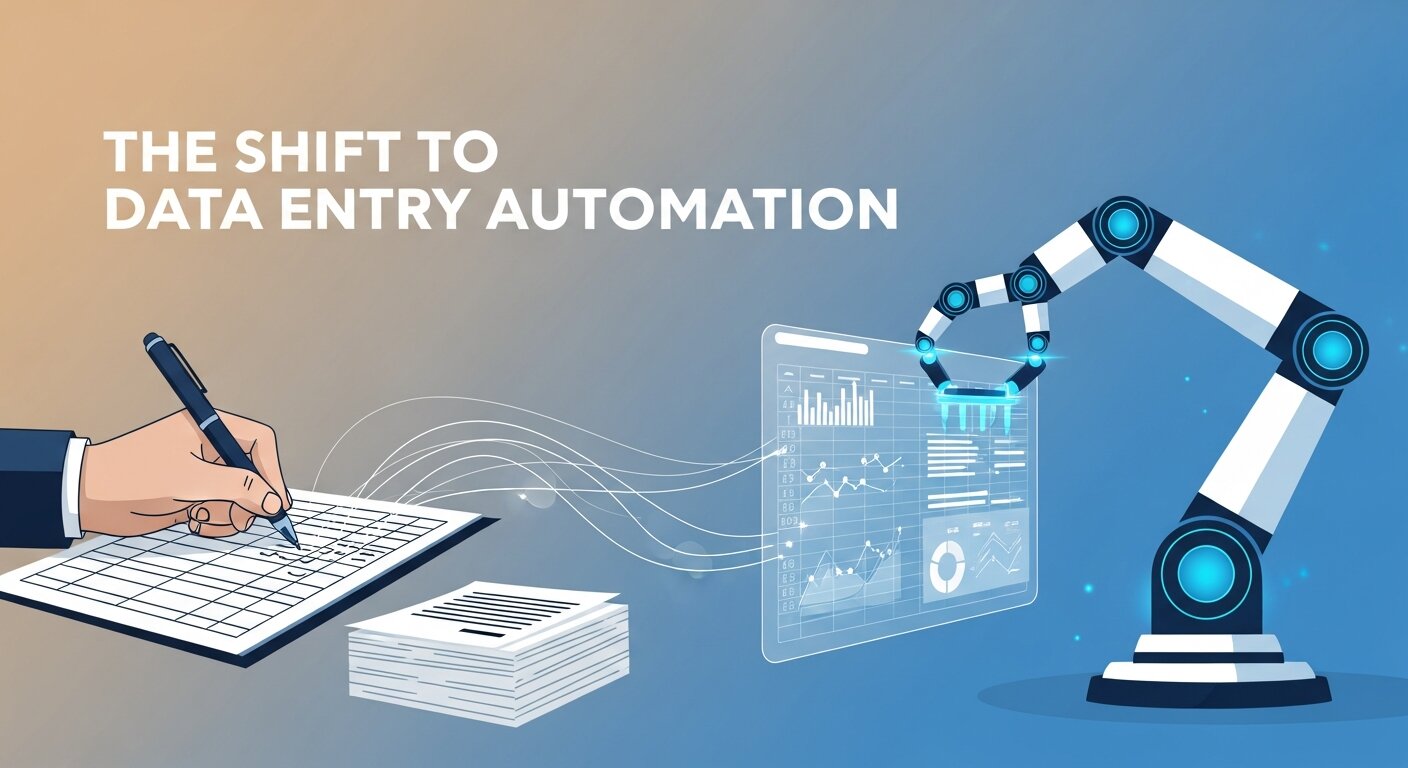
While manual data entry will always have a place, the future lies in mastering automation in excel data entry and beyond.
Leveraging AI and Machine Learning
Artificial intelligence in business is no longer a luxury. Modern business process automation tools utilize Intelligent Document Processing (IDP) to “read” invoices and receipts. These systems use predictive trend marketing techniques to understand the context of a number—distinguishing between a “Total Amount Due” and a “Tax ID.”
OCR and Barcoding
“Automate website data entry” by using Optical Character Recognition (OCR). This tech converts images of numbers into digital text, bypassing the human element entirely. Similarly, barcode scanning for inventory ensures that numeric data entry for SKUs is instantaneous and perfect.
Industry-Specific Considerations
The stakes for numeric data entry vary by sector:
- Healthcare: Decimal point errors in medication dosages can be fatal. Mastering real time data is vital for patient monitoring.
- Finance: Automated data entry Xero or QuickBooks integrations help small businesses avoid the “Manual invoice data entry” trap.
- Digital Marketing: Marketing analytics data drives your content marketing plan. If your digital marketing analytics are based on flawed numbers, your entire brand strategy road map will be off-course.
Enhancing Productivity Through Ergonomics and Training
You cannot expect high-level numeric data entry performance from a fatigued or untrained workforce.
1. Professional Training
Don’t assume everyone knows how to use a numeric keypad. Specialized training in textual data entry and numeric shorthand can boost both speed and accuracy.
2. Creating the Right Environment
Optimize the workstation. According to Ahrefs, even small improvements in internal processes—like reducing noise or improving lighting—can lead to better performance metrics. This is especially true for virtual assistants working remotely.
3. Using Text Expansion Software
To speed up repetitive numeric data entry, use text expansion software. This allows operators to type a short code that expands into a longer string of numbers, reducing the chance of individual keystroke errors.
Measuring Performance: KPIs for Numeric Data Entry
To improve, you must measure. Track these Key Performance Indicators (KPIs):
- Error Rate: The number of mistakes per 1,000 keystrokes.
- Keystrokes Per Hour (KPH): A measure of pure speed.
- Corrected Error Rate: How many errors were caught by the system vs. how many made it into the final database.
- Field Accuracy: Which specific fields (e.g., “Zip Code” vs. “Price”) see the most errors?
The Role of Data Entry in the Broader Marketing Ecosystem
It might seem that numeric data entry is far removed from “Viral marketing strategies” or “Brand personality in marketing,” but they are deeply linked.
Effective marketing analytics tools rely on clean data to calculate Brand equity KPIs and Brand awareness metrics. If your event marketing analytics from a recent unforgettable online event are entered incorrectly, you won’t know if your webinar sales funnel actually worked.
Whether you are looking at luxury brand marketing strategy or B2B lead generation, your digital reputation management depends on the truth found in your numbers.
Advanced Technologies: Blockchain and Beyond

For the ultimate in numeric data entry integrity, some organizations are turning to blockchain. Because blockchain creates an “Immutable record,” once a number is entered and verified, it cannot be changed without leaving a clear audit trail. This is a game-changer for digital payment solutions and reputation management.
To further expand your comprehensive guide on Numeric Data Entry, here are several high-value sections focusing on technical implementation, modern workflows, and strategic management. These sections are optimized with the requested LSI keywords and provide actionable depth.
Mastering Real Time Data Transfer in Numeric Systems
In the modern business landscape, data is only as valuable as its speed. Mastering real time data transfer ensures that as soon as a numeric value is entered—be it a stock price, a patient’s heart rate, or a warehouse count—it is instantly reflected across all integrated platforms.
The Synchronization Challenge
When moving from manual data entry to synchronized systems, the risk of “data collisions” increases. To mitigate this, organizations are adopting:
- API-First Architectures: Allowing different software (like a CRM and an ERP) to “talk” to each other without manual intervention.
- Mastering Video Analytics: In retail, video feeds can now be converted into numeric foot-traffic data in real-time, bypassing the need for human counters.
- Automated CRM Data Entry: Ensuring that sales figures are updated live, providing a “single source of truth” for the entire organization.
Automation Strategies: From Excel to Enterprise Solutions
For many small businesses, the journey begins with mastering automation in excel data entry. However, as a company grows, the tools must evolve to prevent “Brand cannibalization” of internal resources (where employees spend more time fixing data than generating revenue).
Progressive Automation Steps
- Automate Excel Spreadsheets: Use Macros and Power Query to clean and format numeric strings automatically.
- Automate Website Data Entry: Use browser extensions or RPA (Robotic Process Automation) to automate browser data entry, moving numbers from web forms into local databases.
- Automated Data Entry Xero/QuickBooks: Connect your bank feeds directly to your accounting software to eliminate manual invoice data entry.
- AI-Driven Trend Marketing: Use the cleaned numeric data to feed predictive models that forecast future sales trends.
The Intersection of Data Accuracy and Brand Strategy
It may seem counterintuitive, but numeric data entry is a pillar of brand strategy consulting guide development. Without accurate numbers, your brand positioning strategy is based on guesswork.
How Data Integrity Protects Your Brand
- Brand Crisis Management: Inaccurate financial reporting can lead to a PR nightmare. Clean data ensures your “Digital reputation management” remains intact.
- Luxury Brand Marketing Strategy: High-end brands rely on “Exclusivity metrics.” If customer purchase history (numeric data) is flawed, the personalized experience is ruined.
- Brand Equity KPIs: Calculating the value of your brand requires precise numeric inputs regarding market share, consumer sentiment scores, and revenue premiums.
Advanced Validation: Checksums and Mathematical Integrity

For mission-critical data, simple “Range Checks” are not enough. Numeric data entry professionals often utilize mathematical algorithms to ensure 100% integrity.
Common Mathematical Safeguards
- Luhn Algorithm (Mod 10): Used worldwide to validate credit card numbers and IMEI numbers.
- Weighting Systems: Assigning a “weight” to each digit position in a sequence to identify transposition errors that a simple sum might miss.
- Cross-Field Reconciliation: If “Quantity” (Field A) multiplied by “Unit Price” (Field B) does not equal “Total” (Field C), the system should block the entry immediately.
Training the Next Generation: Data Entry in the AI Era
As we move toward artificial intelligence in business, the role of the data entry specialist is shifting from “typist” to “data auditor.”
New Skillsets for Modern Operators
- Error Pattern Recognition: Training staff to use marketing analytics tools to spot anomalies.
- Virtual Assistant Proficiency: Teaching remote teams how to use text expansion software and business process automation tools to maintain high KPH (Keystrokes Per Hour) without sacrificing quality.
- Webinar for Education: Many firms now use a webinar guide to train global teams on new numeric data entry protocols, ensuring consistency across different time zones.
Quality Control Methodologies
To maintain a high standard, implement a “Continuous Feedback Loop.” Use marketing analytics hacks to audit your own data entry team’s performance.
| Methodology | Application | Objective |
| Statistical Sampling | Reviewing 5% of all entries | Identifying systemic errors |
| Root Cause Analysis | Investigating why a specific “Field” has high error rates | Redesigning UI/UX |
| Incentive Mapping | Rewarding “Zero Error” months | Building a culture of accuracy |
| Automated Branding | Using clean data to trigger automated marketing | Enhancing customer journey |
Conclusion
Excellence in numeric data entry is a competitive advantage. By combining high-tech data entry automation software with rigorous human training and validation protocols, organizations can transform their data from a liability into a strategic asset. Accuracy isn’t just a goal—it’s the foundation of every digital marketing success story and operational triumph.
FAQs
1. What is the difference between manual and automated numeric data entry?
Manual data entry involves a human operator typing numbers into a system. Automated data entry uses tools like OCR or IDP to extract and input numbers without human intervention, significantly increasing speed and reducing errors.
2. How can I reduce transposition errors in my spreadsheets?
The best way is to implement checksum algorithms or “Double-entry systems.” You can also use mastering automation in excel data entry to create validation rules that flag numbers that don’t fit expected patterns.
3. Is “Numeric Data Entry” a viable career for a Virtual Assistant?
Absolutely. Many businesses outsource their numeric data entry to a virtual assistant to handle tasks like Hubspot data entry or automated CRM data entry. Precision and familiarity with business process automation tools are key skills.
4. What is the impact of poor data entry on B2B Lead Generation?
If contact numbers or budget figures are entered incorrectly during B2B lead generation, sales teams waste time calling “dead” leads or pitching the wrong solutions, directly impacting the webinar sales funnel.
5. How does OCR help with numeric data entry?
OCR (Optical Character Recognition) converts printed or handwritten numbers into digital data. This is essential for manual invoice data entry tasks, as it allows for “Automated data entry Xero” and other accounting software integrations.
6. Can I use text expansion software for numbers?
Yes. Text expansion software is highly effective for frequently used numeric strings, such as tax IDs or internal SKU headers, ensuring they are entered perfectly every time.
7. Why is ergonomics important for data entry operators?
Good ergonomics—proper chair height, monitor level, and lighting—reduces physical strain. Less strain leads to higher concentration levels, which is the best defense against numeric data entry lapses.
8. What role does AI play in data entry today?
Artificial intelligence in business is used to identify patterns and anomalies. For example, AI can flag a numeric data entry that deviates from historical norms, acting as an advanced real-time auditor.
9. How do I choose the right platform for a webinar if I need to collect attendee data?
Look for the right platform for webinar that offers seamless integration with your CRM. This allows for automated CRM data entry, ensuring attendee counts and engagement metrics are recorded without manual errors.
10. What are the best KPIs to track for my data entry team?
Focus on “First-time accuracy” and “Error rate per field.” While speed (KPH) is important, accuracy is the metric that prevents costly financial and operational “brand crisis management” scenarios.