Scalable automation is becoming an essential part of modern business operations because companies need to improve productivity while managing growing workloads and operational costs. As businesses expand, manual processes can create delays, increase errors, and make it difficult for employees to focus on strategic activities. Scalable automation helps organizations manage these challenges by automating repetitive tasks, streamlining workflows, and adapting systems to changing business demands.
From small businesses to large enterprises, automation can improve operational consistency and support sustainable growth. By combining Automated task management, Enterprise automation, and AI Task automation, businesses can build efficient processes that accommodate increasing workloads without requiring a proportional increase in manual effort.
Understanding Scalable Automation in Business
Scalable automation refers to the ability of automated systems and workflows to handle increasing workloads, users, transactions, or operational complexity without requiring a complete redesign. It enables businesses to expand their operations while maintaining productivity, reliability, and service quality. Unlike isolated automation tools, scalable systems are designed to support long-term business development and evolving operational requirements.
How Scalable Automation Works
Scalable automation works by identifying repetitive processes, establishing clear workflows, and using software to execute tasks with minimal manual intervention. These processes can include customer communications, data entry, reporting, inventory updates, and employee notifications. As demand increases, businesses can expand their automation capabilities through additional integrations, computing resources, or workflow configurations.
For example, an online retailer may initially automate order confirmations and inventory updates. As sales increase, the same automation framework can support shipping notifications, customer service requests, and sales reporting. This approach allows businesses to expand operational capacity while maintaining consistent processes and reducing unnecessary administrative work.
The Difference Between Basic and Scalable Automation
Basic automation usually addresses a specific task or isolated problem, such as sending an email after a customer submits a form. Scalable automation connects multiple processes and supports higher workloads as business needs evolve. It focuses on flexibility, integration, monitoring, and maintainability rather than simply replacing one manual activity.
The distinction matters because businesses often outgrow disconnected automation tools. A scalable approach creates a foundation that can accommodate new departments, applications, customers, and services without introducing excessive complexity. This makes automation a long-term operational strategy rather than a temporary productivity improvement.
How Scalable Automation Improves Business Efficiency
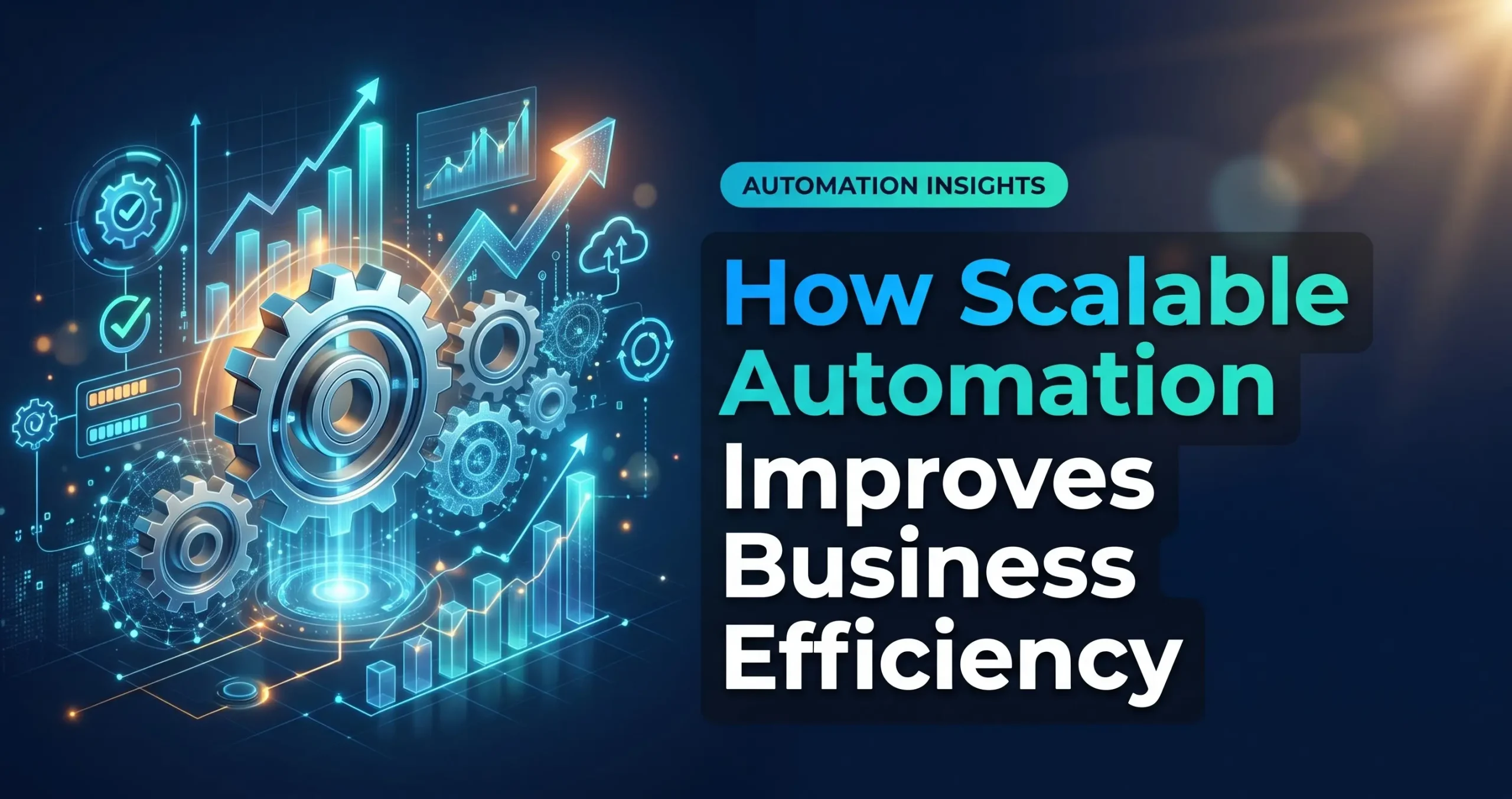
Scalable automation improves efficiency by reducing repetitive work, accelerating routine processes, and creating more consistent operating procedures. Employees spend less time completing administrative activities and more time solving problems, supporting customers, and developing business strategies. When automation is designed around measurable objectives, organizations can improve productivity while maintaining control over quality and operational performance.
Reducing Repetitive Manual Work
Repetitive manual tasks consume valuable employee time and increase the possibility of human error. Activities such as copying information between applications, preparing routine reports, updating spreadsheets, and sending standard notifications can often be automated. Removing these repetitive responsibilities allows employees to concentrate on activities that require creativity, judgment, and communication.
Scalable automation also ensures that routine work can continue as demand increases. For instance, a marketing team can automatically organize incoming leads, update customer records, and notify sales representatives when prospects meet predefined criteria. As lead volume grows, the workflow can process more records without requiring employees to perform every step manually.
Improving Workflow Speed and Accuracy
Automated workflows can execute predefined tasks consistently and transfer information between connected systems with fewer manual handoffs. This reduces delays caused by waiting for approvals, searching for records, or entering the same information repeatedly. Faster processing can improve internal coordination and help businesses respond to customers more efficiently.
Accuracy also improves when automated processes include validation rules, exception handling, and reliable data integrations. However, automation does not eliminate every error. Incorrect rules or poor-quality source data can produce inaccurate results at scale, making testing, monitoring, and human oversight essential components of an effective automation strategy.
The Role of Automated Task Management in Productivity
Automated task management helps businesses assign work, monitor progress, organize deadlines, and trigger actions according to predefined rules. Instead of relying entirely on manual reminders and status updates, teams can use automation to coordinate routine responsibilities across departments. When integrated with broader business systems, task management automation can improve accountability, reduce missed deadlines, and make workloads easier to manage.
Automating Task Assignment and Scheduling
Task assignment automation can distribute responsibilities based on workload, employee roles, project requirements, or predefined business rules. For example, a customer support system can assign incoming tickets to the appropriate team according to issue type and priority. Project management software can also create tasks automatically when a milestone is reached or a request receives approval.
Automated scheduling reduces the need for repeated coordination and helps employees understand their responsibilities. Managers can establish escalation rules for overdue tasks and receive notifications when projects require attention. These capabilities are particularly useful for growing teams that manage multiple projects, customers, and operational deadlines simultaneously.
Tracking Performance and Task Completion
Automated task management systems can collect information about completion times, overdue activities, workload distribution, and workflow bottlenecks. Managers can use these insights to understand where delays occur and determine whether processes require additional resources or redesign.
Performance tracking should focus on meaningful outcomes rather than simply measuring the number of completed tasks. Combining task data with customer satisfaction, service quality, and project results provides a more complete understanding of productivity. This allows businesses to improve their workflows without encouraging employees to prioritize speed over accuracy.
Enterprise Automation for Large-Scale Operations
Enterprise automation connects business processes across departments, applications, and operational systems. Large organizations often manage complex workflows involving finance, human resources, sales, customer service, and supply chain operations. Coordinating these activities manually can create inconsistencies and delays. Enterprise automation establishes repeatable processes that help organizations manage complexity while maintaining visibility, governance, and operational control.
Connecting Business Systems and Departments
Disconnected software systems often force employees to transfer information manually between applications. Enterprise automation can connect customer relationship management platforms, accounting software, enterprise resource planning systems, and communication tools. These integrations allow approved information to move between departments according to predefined rules.
For example, when a sales team closes a deal, an integrated workflow may notify finance, create an onboarding task, and update the customer record. This reduces duplicate data entry and helps departments work with consistent information. Businesses should evaluate integration compatibility, access permissions, and data quality before connecting critical systems.
Supporting Security and Operational Governance
Large-scale automation requires clear governance because automated workflows may access sensitive information or initiate important business actions. Organizations should establish role-based permissions, approval requirements, audit trails, and procedures for handling exceptions. These safeguards help ensure that automated processes operate within company policies and applicable regulations.
Security also requires regular reviews of integrations, credentials, and system access. Businesses should document workflow ownership and define who can modify automation rules. With appropriate controls, enterprise automation can improve efficiency without sacrificing accountability or exposing critical operations to unnecessary risk.
How AI Task Automation Expands Business Capabilities
AI Task automation uses artificial intelligence to assist with tasks that involve interpreting information, identifying patterns, classifying content, or generating responses. Unlike traditional rule-based automation, which follows predefined instructions, AI-enabled workflows can support activities involving less structured information. When combined with established business processes, AI can help organizations handle complex workloads while reserving human attention for decisions that require expertise and judgment.
Automating Data Analysis and Decision Support
AI-powered tools can analyze large volumes of operational data, identify unusual patterns, summarize reports, and help employees recognize emerging trends. Businesses may use these capabilities to evaluate customer feedback, classify support requests, or identify potential supply chain problems. These insights can improve decision-making when supported by reliable data and appropriate validation.
AI should not automatically replace human review in situations involving financial commitments, sensitive customer information, legal obligations, or significant business risks. Organizations should establish clear boundaries for automated decisions and verify important outputs before acting on them. This balanced approach allows AI to improve productivity while limiting the consequences of inaccurate results.
Improving Customer Communication
AI automation can support customer communication by categorizing incoming messages, suggesting responses, routing inquiries, and providing answers to common questions. These capabilities can help support teams manage larger request volumes and respond more quickly during busy periods.
However, effective customer communication requires more than speed. Businesses should maintain consistent brand messaging, protect customer information, and provide access to human support when automated systems cannot resolve an issue. Monitoring response quality and customer satisfaction helps organizations determine where AI automation is useful and where personal assistance remains necessary.
Strategies for Implementing Scalable Automation
Implementing scalable automation successfully requires more than purchasing software. Businesses must understand their existing workflows, establish measurable objectives, select suitable technologies, and prepare employees for operational changes. A structured implementation process helps organizations avoid unnecessary complexity and ensures that automation supports actual business needs instead of creating additional administrative burdens.
Identify High-Impact Automation Opportunities
Businesses should begin by examining processes that involve repetitive work, frequent delays, high transaction volumes, or preventable errors. Examples include invoice processing, appointment reminders, customer onboarding, report generation, and lead assignment. Evaluating these activities helps organizations identify opportunities where automation can produce meaningful operational improvements.
Each opportunity should be assessed according to its business value, implementation complexity, risk, and expected maintenance requirements. Starting with a manageable workflow allows teams to test assumptions and learn from practical results. Once the initial process performs reliably, businesses can expand automation into connected activities.
Choose Flexible and Compatible Technologies
The right automation technology should support current business requirements while allowing future expansion. Companies should consider integration capabilities, scalability, security features, usability, reporting, and total ownership costs. A platform that works well for a small workflow may become difficult to maintain if it cannot accommodate additional applications or more complex business rules.
Compatibility is especially important when organizations use multiple software platforms. Businesses should evaluate available application programming interfaces, integration connectors, data formats, and vendor support before making long-term commitments. Selecting flexible tools reduces the likelihood of expensive system replacements as operations grow.
Monitor Results and Improve Workflows
Automation requires continuous evaluation because business processes, customer expectations, and technology requirements change over time. Organizations should monitor processing time, error rates, operating costs, workflow completion, and customer experience. Comparing these indicators with pre-implementation baselines helps determine whether automation is delivering measurable value.
Regular reviews can also reveal unnecessary steps, failed integrations, and workflows that no longer reflect current policies. Businesses should assign clear ownership for maintenance and establish procedures for testing changes before deployment. Continuous improvement keeps automation reliable, relevant, and aligned with evolving operational objectives.
Common Challenges in Scalable Automation
Although scalable automation can deliver significant benefits, implementation challenges may arise when organizations overlook process design, employee readiness, data quality, or ongoing maintenance. Understanding these obstacles helps businesses make realistic investment decisions and develop systems that remain useful as operations expand. Effective automation depends on a combination of suitable technology, clear governance, and well-managed organizational change.
Managing Integration and Data Quality
Automation systems depend on accurate information and reliable connections between applications. Inconsistent records, outdated databases, and incompatible software can interrupt workflows or produce incorrect outputs. Before expanding automation, businesses should review their data structures, establish validation rules, and test integrations under realistic operating conditions.
Organizations should also prepare fallback procedures for failed connections or incomplete transactions. Error alerts, retry mechanisms, and exception queues help teams identify problems before they affect a large number of customers or business records.
Preparing Employees for Change
Employees may worry that automation will make their roles less valuable or introduce unfamiliar responsibilities. Clear communication, practical training, and employee involvement can reduce uncertainty and improve adoption. Businesses should explain which activities will be automated, how responsibilities may change, and where human expertise will remain important.
Training should cover both routine operation and exception handling. Employees need to understand how to recognize automation failures, escalate unusual cases, and provide feedback about workflow performance. Treating automation as a tool that supports employees can encourage collaboration and help organizations realize its full productivity potential.
The Future of Scalable Automation

Scalable automation is expected to become increasingly connected with AI, cloud platforms, workflow orchestration, and real-time analytics. These technologies can help businesses coordinate complex processes, respond to changing conditions, and improve visibility across departments. As automation becomes more accessible, organizations of different sizes will have more opportunities to streamline operations and expand their service capabilities.
Future developments may also increase the importance of responsible AI use, transparent decision-making, cybersecurity, and human supervision. Businesses that establish strong governance and flexible technology foundations will be better positioned to adopt new capabilities without creating unnecessary operational risks. The long-term advantage will come from combining intelligent automation with thoughtful process design and continuous improvement.
Conclusion
Scalable automation helps businesses improve efficiency by reducing repetitive work, accelerating workflows, increasing consistency, and supporting growth. Through Automated task management, Enterprise automation, and AI Task automation, organizations can coordinate activities, improve operational visibility, and use employee time more effectively.
Successful implementation requires clear objectives, compatible technologies, reliable data, employee training, and ongoing performance monitoring. Rather than automating every process immediately, businesses should begin with high-impact opportunities and expand gradually as results become clear. By treating automation as a long-term business capability, organizations can build more adaptable operations, manage increasing workloads, and pursue sustainable growth.
Frequently Asked Questions
What is scalable automation?
Scalable automation is the use of automated systems and workflows that can accommodate increasing workloads, users, and business complexity without requiring a complete redesign. It helps organizations maintain operational efficiency as they grow.
How does scalable automation improve business efficiency?
It reduces repetitive manual work, minimizes avoidable errors, accelerates routine processes, and improves coordination between teams. These improvements allow employees to focus on strategic and customer-focused responsibilities.
What is the difference between automation and scalable automation?
Basic automation usually addresses a specific task, while scalable automation is designed to expand across workflows and accommodate growing operational demands. Scalable systems emphasize flexibility, integration, monitoring, and long-term maintainability.
What is automated task management?
Automated task management uses software to assign tasks, schedule activities, send reminders, track progress, and trigger actions based on predefined rules. It helps teams improve accountability and manage deadlines more effectively.
What is enterprise automation?
Enterprise automation coordinates processes across multiple departments and business applications. It can connect finance, sales, human resources, customer service, and other functions to reduce manual work and improve operational consistency.
How does AI task automation help businesses?
AI task automation can classify information, summarize documents, analyze data, route customer inquiries, and assist with content generation. Human oversight remains important when outputs affect sensitive information or significant business decisions.
Is scalable automation suitable for small businesses?
Yes. Small businesses can begin with affordable automation for invoicing, email notifications, appointment scheduling, customer follow-ups, and lead management. They can expand their systems as their workload and budgets increase.
What are the main challenges of scalable automation?
Common challenges include integration problems, poor data quality, security concerns, employee resistance, implementation costs, and ongoing maintenance. Careful planning, training, testing, and governance can help address these issues.
How can businesses measure automation success?
Businesses can measure processing time, error rates, operating costs, task completion rates, customer satisfaction, and employee productivity. Comparing these metrics with baseline performance helps determine whether automation is producing meaningful improvements.
What is the future of scalable automation?
The future will likely involve broader integration of AI, cloud computing, real-time analytics, and connected workflows. Businesses will increasingly need flexible systems, strong cybersecurity, responsible AI practices, and human oversight to achieve sustainable results.