
Generating leads is hard. Nurturing them into paying customers? Even harder. Most marketing teams are stretched thin, juggling campaigns, content, social media, and analytics—all while trying to deliver the right message to the right person at the right time. That’s where marketing automation changes the game.
Marketing automation refers to software and technology that handles repetitive marketing tasks automatically, from sending follow-up emails to scoring leads and tracking customer behavior across multiple channels. And while many businesses adopt it simply to save time, its real power lies in what it unlocks: smarter lead generation, more consistent nurturing, and a measurable lift in conversions.
This post breaks down exactly how marketing automation works, why it matters for lead generation and nurturing, and how intelligent branding solutions and automated workflows are helping modern marketing teams do more with less.
What Is Marketing Automation—and Why Does It Matter Now?
Marketing automation is the use of software to automate repetitive marketing tasks and manage complex, multi-step campaigns without manual effort at every stage. This includes email sequences, social media scheduling, lead scoring, customer segmentation, ad retargeting, and more.
The numbers tell a compelling story. According to HubSpot, businesses that use marketing automation see a 451% increase in qualified leads. Salesforce research shows that high-performing marketing teams are 7.7x more likely to use automation than underperforming ones.
But it’s not just about volume. The shift toward marketing automation reflects a deeper change in how buyers behave. Modern customers move through non-linear journeys—researching independently, comparing options across channels, and expecting personalized experiences at every touchpoint. Manually keeping pace with that is nearly impossible. Automation makes it scalable.
How Marketing Automation Fuels Lead Generation
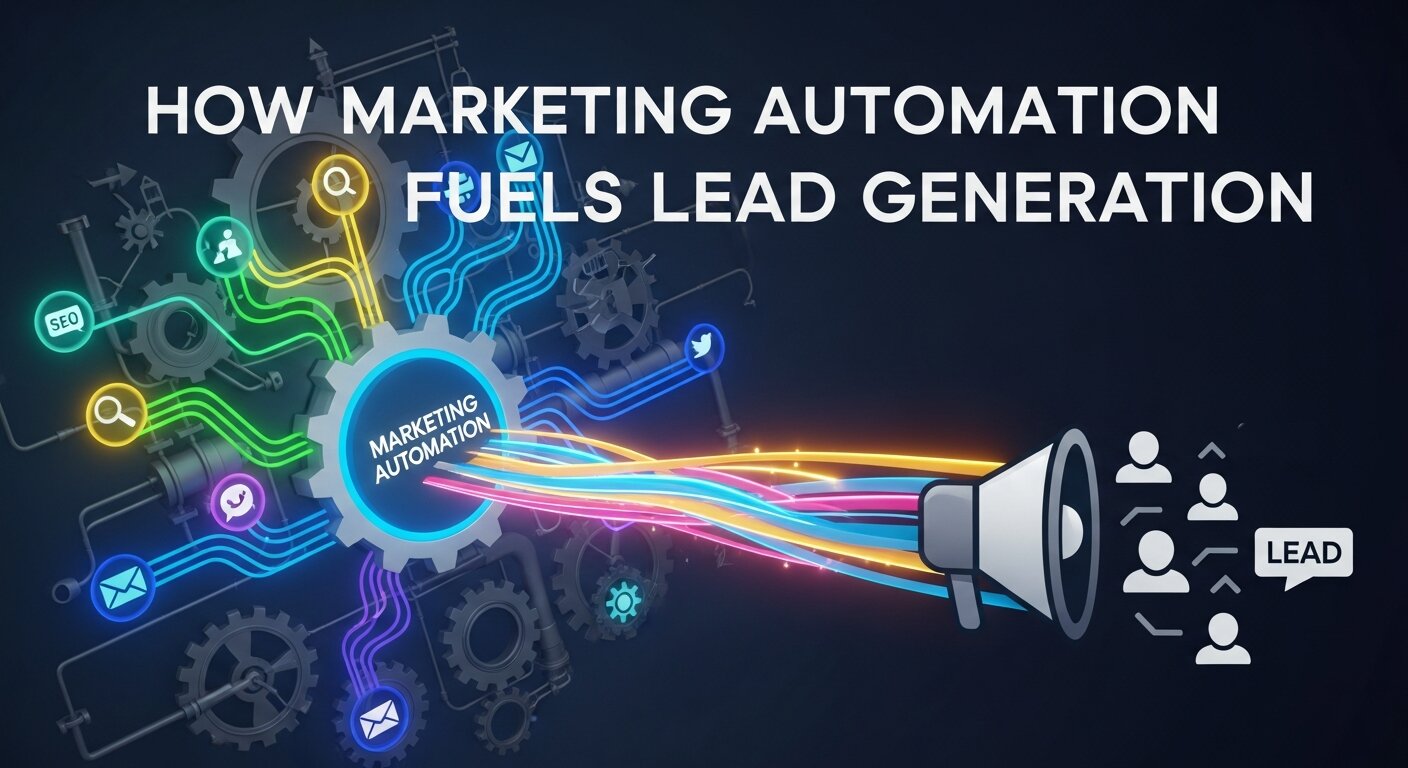
Capturing leads across multiple channels simultaneously
Traditional lead generation often relied on a single entry point—a contact form, a cold call list, or a trade show. Marketing automation expands that significantly, enabling businesses to capture leads through landing pages, chatbots, social media ads, gated content, and email sign-up forms—all feeding into a unified system.
When someone downloads a whitepaper, watches a webinar, or clicks on a retargeted ad, automation tools log that interaction, tag the lead, and trigger the appropriate follow-up. No manual data entry. No leads slipping through the cracks.
This kind of automated brand monitoring—tracking how prospects interact with your content and brand across channels—gives marketing teams a real-time view of where their best leads are coming from, and which touchpoints are driving the most engagement.
Qualifying leads automatically with lead scoring
Not every lead is ready to buy. One of the biggest inefficiencies in marketing and sales alignment is handing off cold leads to the sales team too early—wasting time on both sides and reducing conversion rates.
Marketing automation solves this through lead scoring: a system that assigns numerical values to leads based on their behavior and profile. A prospect who visits your pricing page three times, opens four emails, and matches your ideal customer profile gets a high score. Someone who downloaded a free resource six months ago and hasn’t engaged since gets a low one.
When a lead crosses a predefined score threshold, automation routes them to sales—at exactly the right moment. The result is a shorter sales cycle, higher close rates, and a marketing team that’s measured on lead quality, not just quantity.
Personalizing the top-of-funnel experience at scale
Personalization is no longer a nice-to-have. Research from McKinsey shows that 71% of consumers expect personalized interactions, and 76% get frustrated when they don’t get them.
Marketing automation makes personalization scalable. Using dynamic content, behavioral triggers, and audience segmentation, automation platforms can serve different messages to different audiences based on their industry, location, past behavior, or stage in the buying journey—all without a human manually crafting each variation.
Intelligent branding solutions built on automation take this further, enabling automated brand creation for different segments. Rather than designing a one-size-fits-all campaign, brands can generate tailored content experiences that feel relevant to each prospect—boosting engagement from the very first touchpoint.
How Marketing Automation Strengthens Lead Nurturing
Building email nurture sequences that work while you sleep
Email remains one of the highest-ROI channels in digital marketing—and nurture sequences are where that ROI is truly realized. A well-built automated email sequence guides a lead from initial awareness to purchase consideration through a series of strategically timed, value-driven messages.
The key difference between a broadcast email and a nurture sequence is responsiveness. Nurture sequences adapt based on behavior. If a prospect clicks a link about a specific product feature, the next email in their sequence addresses that feature in more depth. If they don’t open an email after two attempts, the sequence pivots—perhaps sending a different subject line, or switching to a different channel entirely.
This level of responsiveness was once the domain of large enterprises with big teams. Marketing automation puts it within reach for businesses of any size.
Segmenting audiences for more relevant communication
Sending the same message to your entire list is one of the fastest ways to drive up unsubscribes and drive down conversions. Marketing automation enables dynamic segmentation—grouping leads based on shared characteristics or behaviors and delivering content that speaks directly to each group.
A SaaS company, for example, might segment leads by company size, role, and stage in the trial. A B2C brand might segment by purchase history and browsing behavior. In both cases, automated workflows ensure each segment receives content that’s genuinely relevant—improving open rates, click-through rates, and ultimately, conversions.
Segmentation also plays a critical role in automated brand monitoring. By tracking how different audience segments respond to your messaging, automation tools surface insights about which brand narratives resonate—and which fall flat. This feedback loop continuously improves the quality of your nurturing content over time.
Re-engaging leads who have gone cold
Every marketing database has dormant leads—people who showed interest at some point but stopped engaging. Without automation, these leads are often forgotten or deleted. With it, they can be re-engaged systematically.
Re-engagement campaigns are automated sequences triggered by inactivity—say, no email opens in 90 days. They typically offer something fresh: a new piece of content, a limited-time offer, or a check-in message that invites the lead to update their preferences. Done well, these campaigns recover a meaningful percentage of dormant leads and push them back into active nurture tracks.
The cost of re-engaging an existing lead is significantly lower than acquiring a new one. Marketing automation makes this re-engagement proactive rather than reactive.
The Role of Intelligent Branding Solutions in Automated Marketing

One area where marketing automation is rapidly evolving is brand consistency at scale. As businesses scale their content output across email, social, paid ads, and web, maintaining a coherent brand identity becomes increasingly challenging.
Intelligent branding solutions address this by automating brand creation workflows—ensuring that every asset, from an email header to a social media graphic, adheres to brand guidelines without requiring manual review at every step. Templates, dynamic content rules, and brand asset libraries are all managed within the automation platform.
This doesn’t just save design time. It ensures that every lead, at every stage of the funnel, encounters a brand that looks and feels consistent—which builds trust and improves conversion rates over time.
Aligning Sales and Marketing Through Automation
One of the most underrated benefits of marketing automation is what it does for sales and marketing alignment. Historically, these two teams have operated in silos—marketing generating leads with one set of metrics, sales converting them with another.
Automation bridges that gap. Shared dashboards give both teams visibility into the full lead lifecycle. Automated alerts notify sales reps when a lead hits a certain score or takes a high-intent action. CRM integrations ensure that every interaction a lead has with marketing content is visible to the sales team before they pick up the phone.
The outcome is a more coordinated, more efficient revenue operation—where marketing is accountable for lead quality and sales is empowered with context.
Common Mistakes to Avoid When Implementing Marketing Automation
Marketing automation delivers results, but only when implemented thoughtfully. A few common pitfalls can undermine even the most well-resourced rollout.
Over-automating too quickly: Starting with too many workflows before the fundamentals are in place—clean data, strong content, clear segmentation—leads to messy, ineffective automation that alienates leads rather than nurtures them.
Neglecting content quality: Automation amplifies what’s already there. If the underlying content is generic or low-value, no amount of automation will make it convert. Invest in quality content first.
Ignoring data hygiene: Automated systems are only as good as the data they run on. Duplicate records, outdated contact details, and poor tagging practices degrade the performance of every workflow. Regular database audits are essential.
Setting it and forgetting it: Automation is not a one-time setup. Effective marketing teams continuously monitor performance, test variations, and refine their workflows based on results.
Measuring and Optimizing Marketing Automation Performance
Implementing marketing automation is only the beginning. To maximize its impact, businesses need to continuously measure performance and refine their workflows based on real-world results. Automation platforms generate valuable data that reveals how prospects interact with campaigns, where leads lose interest, and which strategies contribute most to revenue growth.
Start by tracking key performance indicators (KPIs) that align with your business goals. Metrics such as lead conversion rate, email open and click-through rates, customer acquisition cost, marketing-qualified leads (MQLs), sales-qualified leads (SQLs), and return on investment (ROI) provide a clear picture of campaign effectiveness. Monitoring these metrics regularly helps identify underperforming workflows before they negatively affect sales. A/B testing is another essential optimization practice. Testing different subject lines, email content, landing pages, calls to action, and workflow timing enables marketers to make data-driven improvements rather than relying on assumptions. Even small adjustments can significantly increase engagement and conversions over time.
Analytics also reveal opportunities to improve audience segmentation. As customer behaviors evolve, automation rules should adapt accordingly. Updating lead scoring models, refining customer segments, and introducing new behavioral triggers ensure prospects continue receiving relevant, personalized experiences throughout their buying journey. Successful organizations treat marketing automation as an ongoing optimization process instead of a one-time implementation. By combining continuous analysis, regular workflow updates, and customer feedback, businesses can build a marketing automation system that consistently generates qualified leads, strengthens customer relationships, and supports sustainable long-term growth.
Frequently Asked Questions (FAQs)
1. What is marketing automation?
Marketing automation is the use of software to automate repetitive marketing tasks such as email campaigns, lead scoring, customer segmentation, social media scheduling, and workflow management. It helps businesses engage prospects more efficiently while improving productivity and campaign performance.
2. How does marketing automation improve lead generation?
Marketing automation captures leads from multiple channels, tracks their interactions, and automatically triggers personalized follow-up actions. This helps businesses generate more qualified leads while reducing manual work and minimizing missed opportunities.
3. What is lead nurturing in marketing automation?
Lead nurturing is the process of building relationships with prospects through automated, personalized communication. It delivers relevant content based on user behavior, guiding leads through the buyer’s journey until they are ready to make a purchase.
4. How does lead scoring work?
Lead scoring assigns points to prospects based on demographics, engagement, and buying behavior. High-scoring leads are automatically identified as sales-ready, allowing sales teams to focus on the most promising opportunities and improve conversion rates.
5. Can marketing automation personalize customer experiences?
Yes. Marketing automation uses audience segmentation, behavioral triggers, and dynamic content to deliver personalized emails, offers, and recommendations. This creates more relevant customer experiences and increases engagement throughout the marketing funnel.
6. What are the benefits of integrating marketing automation with a CRM?
Integrating marketing automation with a CRM provides a unified view of customer interactions, improves sales and marketing alignment, automates lead handoffs, tracks the customer journey, and enables more informed decisions based on real-time data.
7. Is marketing automation suitable for small businesses?
Absolutely. Small businesses can use marketing automation to save time, nurture leads consistently, manage campaigns efficiently, and compete with larger organizations without significantly increasing marketing resources or staffing costs.
8. What are the biggest mistakes to avoid with marketing automation?
Common mistakes include automating too many processes at once, using poor-quality content, neglecting database maintenance, failing to segment audiences, and not regularly reviewing workflow performance or campaign results.
9. How do intelligent branding solutions support marketing automation?
Intelligent branding solutions help maintain consistent messaging, visual identity, and customer experiences across multiple marketing channels. They automate brand asset management and content delivery while ensuring every campaign aligns with established brand guidelines.
10. How can businesses measure the success of marketing automation?
Success can be measured using key performance indicators such as lead generation, conversion rate, email open and click-through rates, customer acquisition cost, sales pipeline growth, customer lifetime value, and overall return on marketing investment (ROI).
The Path Forward: Building a Marketing Automation Strategy That Scales
The strongest marketing automation strategies share a few common traits: they start with a clear understanding of the customer journey, they prioritize personalization over volume, and they treat automation as a foundation for better human connection—not a replacement for it.
Start by mapping your lead journey from first touch to closed deal. Identify the highest-friction points—where leads drop off, where follow-up is inconsistent, where personalization is lacking. Then build automation to address those specific gaps.