
Businesses today manage a growing number of repetitive tasks across marketing, customer service, sales, operations, and administration. Completing these activities manually can consume valuable time and increase the possibility of human error. AI Task automation provides a practical way to streamline repetitive workflows by using artificial intelligence to perform, organize, and optimize tasks with limited manual intervention.
AI-powered automation can analyze information, recognize patterns, generate content, organize data, respond to routine requests, and trigger actions based on predefined conditions. Unlike traditional automation, which generally follows fixed rules, AI-based systems can use data and machine learning capabilities to handle more complex processes.
What Is AI Task Automation?
AI task automation is the use of artificial intelligence technologies to perform repetitive or process-based tasks automatically. These systems can combine machine learning, natural language processing, data analysis, and workflow automation to complete activities that would otherwise require manual effort.
Traditional automation usually follows predetermined rules. AI automation can go further by analyzing information, identifying patterns, and adapting certain actions based on available data.
How AI Task Automation Works
AI task automation generally begins with a specific trigger or input. The system processes the information using AI models, applies predefined rules or learned patterns, and then performs an appropriate action.
For example, an AI system can analyze incoming customer messages, identify their purpose, and direct them to the appropriate workflow. Similar processes can be applied to marketing, reporting, data organization, and content management.
Why Businesses Are Adopting AI Task Automation

Organizations are increasingly looking for ways to reduce repetitive work and improve operational efficiency. Employees may spend significant amounts of time entering data, preparing reports, organizing information, responding to routine requests, and managing recurring workflows.
AI automation can handle many of these activities quickly and consistently. This can help businesses make better use of employee time while improving the speed of routine operations.
Reducing Repetitive Work
Repetitive tasks can take attention away from higher-value responsibilities. AI automation can manage routine activities such as data classification, document processing, email sorting, scheduling, and notifications.
By moving these tasks into automated workflows, employees can dedicate more time to strategic planning, problem-solving, customer relationships, and creative work.
Improving Workflow Efficiency
AI automation can connect different business systems and trigger actions automatically. For example, a new lead can enter a CRM system, receive an automated response, and be assigned to an appropriate sales workflow.
Connected processes can reduce unnecessary manual steps and create a more structured operational environment.
AI Task Automation in Marketing
Marketing is one of the areas where AI automation can support a wide range of activities. Marketing teams manage content, customer data, campaigns, analytics, social media, email communication, and lead generation.
AI-powered workflows can help marketers organize these activities and automate repetitive processes while keeping human marketers involved in strategy and creative decisions.
Marketing Analytics
Marketing analytics involves collecting and analyzing marketing data to understand campaign performance, customer behavior, and business outcomes. AI can automate parts of this process by processing large amounts of information and identifying patterns.
Automated analytics workflows can help teams monitor important metrics, identify changes in campaign performance, and organize reports. This allows marketers to spend less time manually compiling data and more time interpreting insights.
Automating Lead Management
AI automation can help businesses organize and prioritize leads based on available information. Systems can categorize prospects, update records, trigger follow-up messages, and notify sales teams when specific conditions are met.
This can create a smoother connection between marketing and sales teams while reducing repetitive administrative work.
Content Automation and AI Workflows
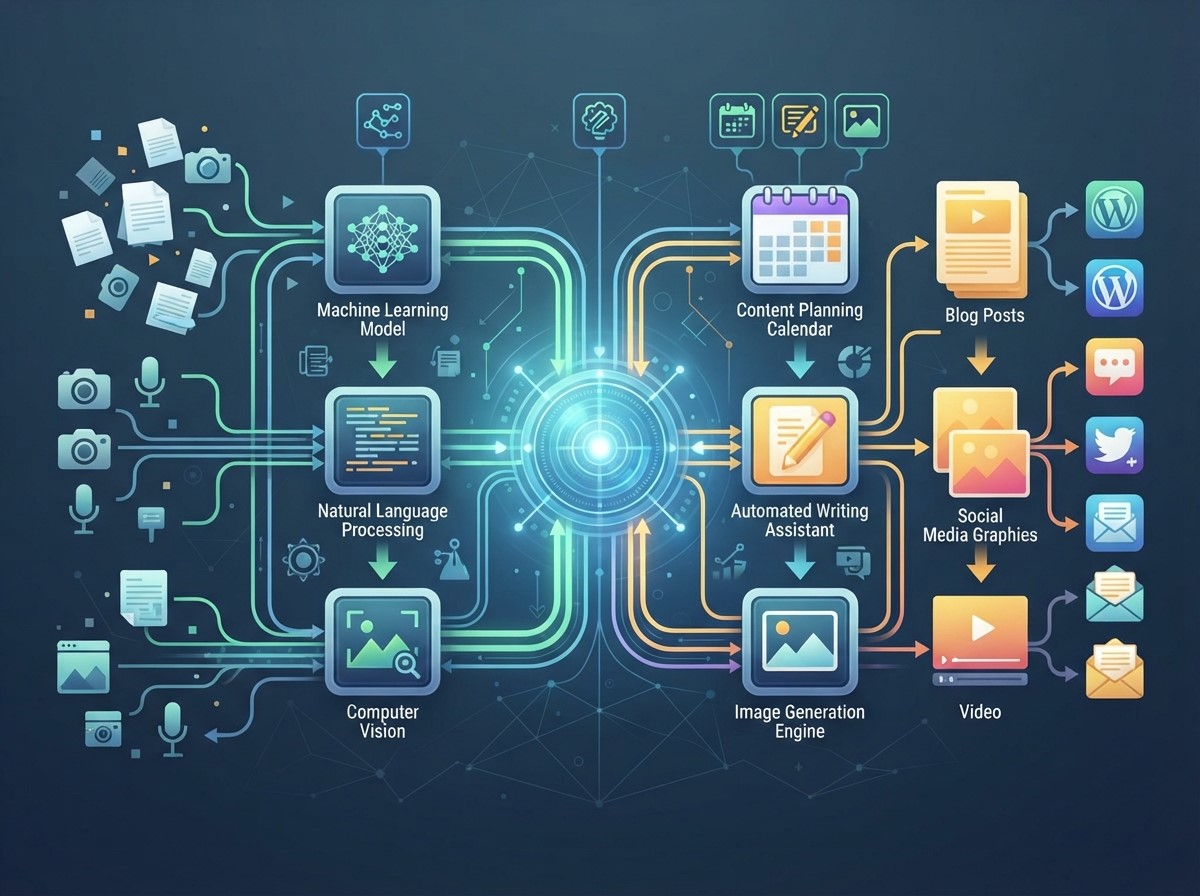
Content automation uses technology to streamline activities involved in content creation, organization, distribution, and management. AI can assist with tasks such as generating content ideas, creating drafts, categorizing content, summarizing information, and preparing content for different channels.
However, automation should not eliminate editorial review. Human oversight remains important for accuracy, originality, brand voice, and audience relevance.
Automating Content Distribution
Businesses often create content for websites, email campaigns, social media, and other digital channels. AI automation can help distribute approved content according to predefined schedules and workflows.
For example, a published article can trigger a series of promotional activities across different channels. This can reduce repetitive publishing work while extending the reach of existing content.
Personalizing Content Experiences
AI systems can analyze customer information and engagement patterns to help deliver more relevant content. Businesses may use these insights to organize audiences into different segments and create automated communication workflows.
Personalization can make automated marketing more useful when it is based on accurate information and appropriate customer consent.
Machine Learning for Marketing
Machine learning for marketing allows systems to identify patterns in customer and campaign data and use those patterns to support marketing decisions. Machine learning models can analyze historical information and recognize relationships that may be difficult to identify manually.
Marketing teams can use machine learning to support customer segmentation, recommendation systems, predictive analysis, campaign optimization, and behavioral insights.
Predictive Customer Insights
Machine learning can examine historical customer behavior to identify patterns related to engagement, purchases, or interactions. These insights can help businesses understand different audience segments and plan more relevant marketing activities.
Predictive systems should be regularly evaluated because customer behavior can change over time. Data quality and model performance also influence the usefulness of automated insights.
Automated Audience Segmentation
AI can help businesses classify customers based on characteristics such as engagement, purchase history, interests, or interactions with marketing campaigns.
Automated segmentation can make it easier to create targeted workflows. Instead of manually organizing large customer lists, marketing teams can use automated rules and AI-supported analysis to maintain audience groups.
AI Task Automation for Customer Service
Customer service teams frequently handle repetitive questions and requests. AI-powered automation can assist with frequently asked questions, ticket classification, routing, status updates, and initial customer responses.
AI Chatbots and Automated Responses
AI chatbots can provide immediate responses to common customer questions. They can also collect basic information before transferring complex issues to human support representatives.
The most effective approach is to define clear boundaries for automated responses. Complex, sensitive, or unusual customer issues should be transferred to trained human representatives when appropriate.
Automated Ticket Management
AI can analyze incoming support requests and categorize them based on topic or urgency. The system can then route tickets to appropriate teams or trigger predefined workflows.
This can help support departments organize large volumes of requests while reducing manual classification work.
AI Automation for Sales Operations
Sales teams perform many repetitive activities, including lead updates, follow-up reminders, data entry, meeting scheduling, and reporting. AI task automation can streamline several of these processes.
Automated Follow-Ups
AI-powered systems can trigger follow-up activities based on customer interactions. For example, a prospect who requests additional information can automatically enter a follow-up workflow.
Sales representatives can then focus on meaningful conversations rather than manually tracking every routine reminder.
Sales Data Organization
AI automation can help organize customer records and identify missing or outdated information. Automated workflows can update specific fields, notify team members, and maintain consistent data structures.
Accurate information is essential because poor-quality data can reduce the effectiveness of automated systems.
How to Implement AI Task Automation
Successful implementation requires more than selecting an AI tool. Businesses should first identify specific problems, evaluate workflows, define measurable objectives, and determine which activities are appropriate for automation.
Identify Repetitive Tasks
Start by documenting recurring activities across departments. Look for processes that consume significant time and follow predictable patterns.
Tasks such as data entry, scheduling, reporting, email classification, lead organization, and content distribution can often be good candidates for automation.
Select the Right AI Tools
Different workflows require different technologies. A marketing team may need AI analytics and content tools, while customer service teams may require conversational AI or ticket automation.
Businesses should consider integration capabilities, data security, scalability, usability, and human oversight before selecting an automation solution.
Test Before Scaling
Automation should generally be tested on a limited workflow before being deployed across an entire organization. Testing allows teams to identify errors, unexpected outcomes, and integration problems.
Performance should be monitored during the initial stage. Once the workflow produces reliable results, businesses can gradually expand automation to additional processes.
Challenges of AI Task Automation
Although AI automation offers many benefits, it also introduces challenges. Poor-quality data, unclear workflows, inappropriate automation, integration problems, and insufficient human oversight can reduce its effectiveness.
Data Quality and Accuracy
AI systems depend heavily on the quality of the information they receive. Incorrect, incomplete, or outdated data can lead to inaccurate classifications, recommendations, or automated actions.
Businesses should establish data-quality processes and regularly review automated outputs to maintain reliability.
Maintaining Human Oversight
AI should not be treated as completely independent in every business situation. Employees should monitor important workflows and intervene when automated decisions may have significant consequences.
Human oversight can also help identify situations that AI systems may not understand correctly.
Measuring AI Automation Performance

Businesses need clear metrics to determine whether automation is producing meaningful improvements. Measuring performance also helps teams identify workflows that require adjustment.
Useful metrics may include time saved, task completion rates, error rates, response times, conversion rates, customer satisfaction, and operational costs.
Continuous Optimization
AI automation should be reviewed regularly rather than treated as a one-time implementation. Businesses can analyze performance data, identify bottlenecks, update workflows, and improve system instructions.
Continuous optimization helps ensure that automated processes remain aligned with changing business requirements and customer expectations.
Future of AI Task Automation
AI task automation is likely to become increasingly integrated into everyday business operations. Improvements in artificial intelligence, machine learning, natural language processing, and workflow platforms are expanding the range of tasks that can be automated.
Future systems may coordinate multiple workflows across marketing, sales, customer service, finance, and operations. Instead of automating isolated tasks, businesses may increasingly build connected AI-powered workflows that share information across departments.
More Intelligent Business Workflows
As AI systems become more capable, automation can move beyond simple repetitive actions toward more context-aware processes. Systems may analyze information, recommend next steps, and initiate appropriate workflows based on changing conditions.
However, responsible implementation will continue to require data governance, security controls, human oversight, and regular performance evaluation.
Conclusion
AI task automation can help businesses streamline repetitive processes, improve workflow efficiency, and give employees more time for strategic responsibilities. In marketing, technologies such as Marketing analytics, Content automation, and Machine learning for marketing can support data analysis, content workflows, audience segmentation, and campaign management.
Successful automation depends on choosing the right tasks, using reliable data, selecting appropriate tools, and maintaining human oversight. Businesses that approach AI automation as an ongoing process rather than a one-time technology investment can create more organized and scalable workflows.
Frequently Asked Questions
1. What is AI task automation?
AI task automation uses artificial intelligence to perform repetitive or process-based tasks with limited manual intervention. It can analyze information, identify patterns, organize data, generate responses, and trigger workflows.
2. How is AI automation different from traditional automation?
Traditional automation generally follows fixed rules and predefined conditions. AI automation can use technologies such as machine learning and natural language processing to analyze information and handle more complex or variable tasks.
3. How can AI task automation help marketers?
AI can automate activities such as data analysis, lead management, audience segmentation, content distribution, reporting, and customer communication. This can reduce repetitive work and allow marketers to focus on strategy and creative activities.
4. What is content automation?
Content automation uses technology to streamline content-related activities such as planning, creation assistance, organization, distribution, and publishing. AI can support several stages while human review helps maintain quality and brand consistency.
5. What is machine learning for marketing?
Machine learning for marketing uses algorithms to analyze marketing and customer data, identify patterns, and support activities such as segmentation, prediction, personalization, and campaign optimization.
6. Can AI automate marketing analytics?
Yes. AI can assist with collecting, processing, organizing, and analyzing marketing data. Automated systems can monitor metrics and identify patterns, while marketers can interpret the results and make strategic decisions.
7. Can small businesses use AI task automation?
Yes. Small businesses can begin with straightforward workflows such as appointment scheduling, email organization, lead follow-ups, customer support, reporting, and content distribution before expanding automation to more complex processes.
8. Does AI task automation eliminate the need for employees?
AI automation generally supports employees rather than eliminating the need for human involvement in every process. Human expertise remains important for strategy, creativity, judgment, customer relationships, and reviewing important automated decisions.
9. What tasks are suitable for AI automation?
Tasks that are repetitive, rule-based, data-intensive, or frequently performed can be suitable for AI automation. Examples include data organization, reporting, lead classification, content distribution, scheduling, and routine customer responses.
10. How can businesses measure AI automation success?
Businesses can measure automation using metrics such as time saved, task completion rates, error reduction, response times, operational costs, engagement, conversion rates, and customer satisfaction. Regular measurement helps identify opportunities for improvement.