

Most businesses don’t have a productivity problem—they have a process problem. Tasks get duplicated, approvals stall, and valuable employees spend hours on work that a well-configured system could handle in seconds. Intelligent automation changes that equation entirely.
Unlike basic task automation, intelligent automation combines artificial intelligence, machine learning, and workflow automation to handle complex, judgment-based processes—not just repetitive ones. The result? Leaner operations, faster decisions, and teams that can focus on the work that actually moves the needle.
This post breaks down what intelligent automation really means, why it matters for business growth, and how to build a strategy that delivers real results—across marketing, operations, customer service, and beyond.
What Is Intelligent Automation (And How Is It Different from Regular Automation)?
Traditional automation follows fixed rules. It executes the same steps in the same order, every time. Intelligent automation goes further. By layering in AI capabilities—natural language processing, predictive analytics, computer vision—it can interpret unstructured data, adapt to new scenarios, and make context-aware decisions.
Think of it this way: a basic automation tool can send a follow-up email after a form submission. An intelligent automation system can analyze the content of that form, score the lead, route it to the right sales rep, and personalize the follow-up message—all without human intervention.
The core components of intelligent automation typically include:
- Robotic Process Automation (RPA): Automates rule-based digital tasks like data entry, report generation, and system migrations.
- Artificial Intelligence: Adds reasoning and learning capabilities so the system can handle variability.
- Machine Learning: Allows the system to improve its outputs over time based on historical data.
- Natural Language Processing (NLP): Enables systems to understand and generate human language, which is critical for customer-facing applications.
Together, these technologies create systems that don’t just do things faster—they do things smarter.
Why Intelligent Automation Is a Business Growth Driver
Efficiency gains are the obvious benefit, but intelligent automation’s impact on growth runs deeper. When routine decisions and time-consuming processes are handled automatically, human capacity shifts toward strategy, creativity, and customer relationships—the areas that actually differentiate a business.
There are three growth levers intelligent automation pulls simultaneously:
Speed: Automated workflows eliminate the delays that come from manual handoffs, approval bottlenecks, and human error. Processes that once took days can be completed in minutes.
Scale: Automation scales with demand without scaling headcount. A business can onboard ten times the customers without ten times the operational cost.
Intelligence: With AI analyzing data in real time, businesses can act on insights faster—adjusting campaigns, pricing, and inventory before a human analyst would even spot the trend.
For growing businesses especially, this combination is powerful. It allows a lean team to operate with the output and consistency of a much larger one.
How to Build an Intelligent Automation Strategy
Deploying automation tools without a clear strategy is one of the most common mistakes businesses make. Technology alone won’t generate results—what matters is how it’s applied.
Start by Auditing Your Existing Workflows
Before automating anything, map out your current processes. Identify where time is being lost, where errors tend to occur, and which tasks are high-volume but low-complexity. These are your best candidates for automation.
Common audit questions to ask:
- Which tasks are completed the same way, every time?
- Where do approvals or handoffs slow things down?
- Which processes require data from multiple systems?
- Where do errors or inconsistencies typically appear?
This audit becomes the foundation of your automation roadmap. Prioritize the processes that, when automated, will have the greatest impact on productivity or revenue.
Prioritize High-Impact Use Cases First
Intelligent automation works best when it’s applied to processes that are both frequent and consequential. Start with use cases where time savings are clear and measurable, then expand.
Strong early candidates include:
- Lead qualification and CRM updates in sales
- Invoice processing and expense management in finance
- Employee onboarding workflows in HR
- Content scheduling and performance reporting in marketing
Quick wins build internal confidence in automation, which makes it easier to expand the strategy over time.
Choose the Right Tools for Each Function
Not every intelligent automation platform is built for every use case. Selecting tools that integrate well with your existing tech stack—and that your team will actually use—is critical to long-term success.
Look for platforms that offer:
- Native integrations with your CRM, ERP, or project management tools
- Low-code or no-code interfaces for non-technical users
- Built-in analytics so you can measure performance
- Scalability as your needs grow
Avoid the trap of adopting too many disconnected tools. Fragmented automation creates new inefficiencies—the opposite of what you’re trying to achieve.
Intelligent Automation Across Key Business Functions
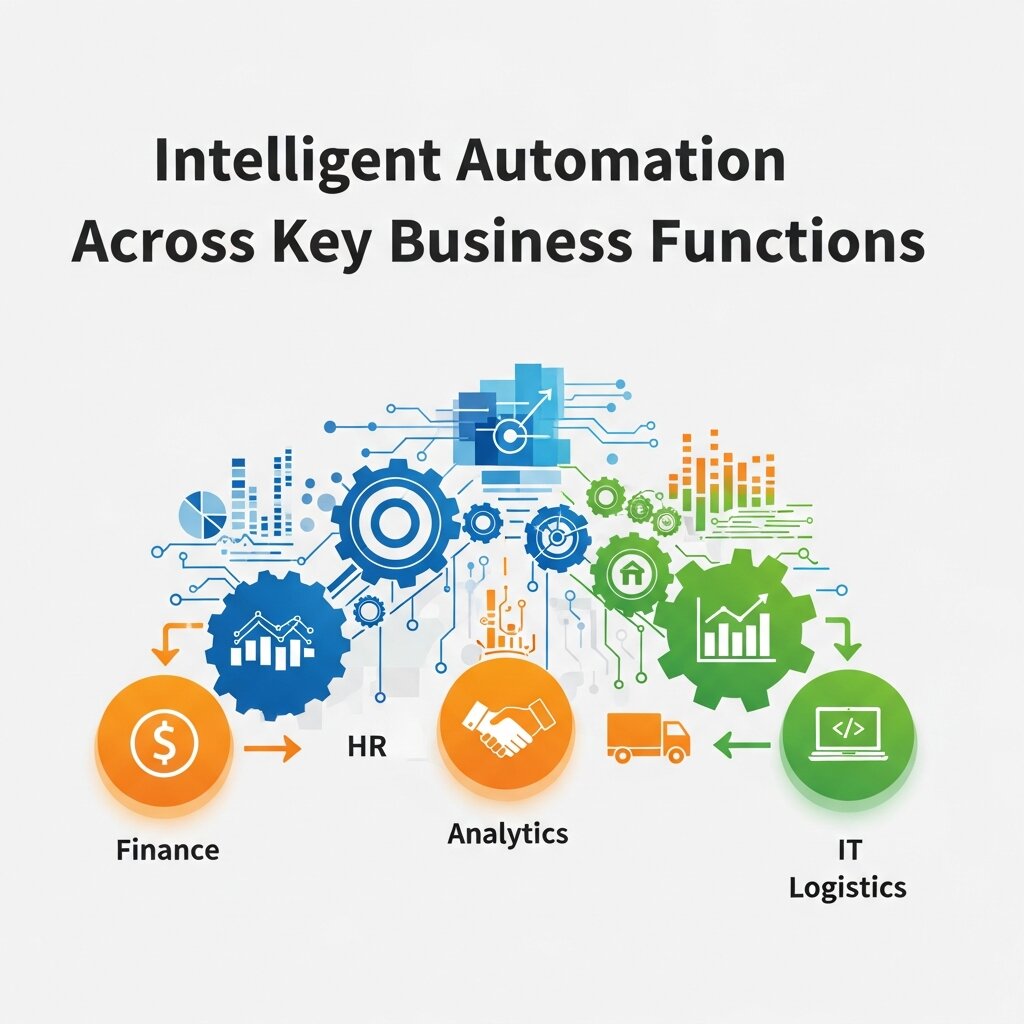
A well-designed intelligent automation strategy doesn’t live in one department. Its value compounds when it’s embedded across the organization.
Workflow Automation in Operations
Operational workflow automation is where most businesses see their fastest returns. By automating data flows between systems, managing task assignments, and triggering actions based on real-time events, operations teams eliminate the friction that slows execution.
For example, connecting your inventory management system to your procurement platform through an intelligent workflow means that reorder triggers happen automatically—based on actual demand data, not someone manually checking a spreadsheet. Delays shrink. Stockouts become rare. And the operations team focuses on supplier relationships and cost optimization instead of administrative monitoring.
Marketing Automation and AI Content Generation
Marketing is one of the highest-impact areas for intelligent automation, largely because of the volume and variety of tasks involved. Marketing automation platforms can handle audience segmentation, campaign scheduling, A/B testing, lead nurturing, and performance reporting—automatically and at scale.
AI content generation takes this a step further. AI writing platforms enable marketing teams to produce blog posts, ad copy, social media content, and email sequences far faster than traditional methods allow. When paired with marketing automation tools, AI-generated content can be personalized, scheduled, and distributed across channels without manual intervention at each step.
The outcome is a content engine that runs efficiently, reaches the right audiences, and frees up strategists to focus on positioning and creative direction—not production tasks.
Intelligent Automation in Customer Service
Customer expectations for speed and availability have risen sharply. Intelligent automation meets those expectations without requiring around-the-clock human staffing.
AI-powered chatbots and virtual agents, built on NLP technology, can handle a significant portion of customer queries—resolving common issues instantly, collecting relevant information, and escalating complex cases to human agents with full context already captured.
The key distinction between a basic chatbot and an intelligent one is adaptability. Intelligent customer service automation learns from interactions, improves response accuracy over time, and can handle varied phrasing of the same question—making it genuinely useful rather than frustrating.
Data Analysis and Decision Support
One of the most underutilized applications of intelligent automation is in business intelligence. Manually pulling data from multiple sources, cleaning it, and building reports is time-consuming work that delays the insights leaders need to make decisions.
Intelligent automation connects data sources, standardizes formats, runs analyses, and surfaces anomalies—automatically. Dashboards update in real time. Alerts trigger when a KPI moves outside expected ranges. Leaders get the information they need when they need it, not 48 hours later.
Over time, machine learning models embedded in these systems become better at predicting outcomes—sales trends, customer churn risk, operational bottlenecks—giving businesses a genuine forward-looking edge.
Common Mistakes to Avoid When Implementing Intelligent Automation
Even the best technology can underdeliver if implementation goes wrong. These are the pitfalls worth watching for:
Automating broken processes: Automation amplifies whatever process it’s built on. If the underlying workflow is inefficient or poorly designed, automating it just makes it fail faster. Fix the process first, then automate it.
Ignoring change management: Employees who don’t understand why automation is being introduced—or who fear it will eliminate their roles—will resist it. Invest in clear communication, training, and transparency about how automation changes (rather than replaces) their work.
Setting and forgetting: Intelligent automation systems require monitoring and refinement. Business needs change, data quality fluctuates, and AI models can drift over time. Build in regular reviews to ensure systems are performing as expected.
Measuring the wrong things: Hours saved is a start, but it’s not the whole picture. Track downstream outcomes: error rates, customer satisfaction scores, revenue impact, and team capacity freed up for high-value work.
Measuring the ROI of Intelligent Automation
Return on investment from intelligent automation comes from multiple directions, and measuring it accurately requires looking beyond direct cost savings.
Key metrics to track include:
- Process cycle time: How long does a process take before and after automation?
- Error rate reduction: How many exceptions or corrections were required previously compared to now?
- Cost per transaction: What does it cost to execute a given process at scale?
- Employee capacity reallocation: How many hours have been redirected to higher-value activities?
- Revenue impact: Have faster processes, better personalization, or improved customer experience driven measurable revenue growth?
For most businesses, the ROI case becomes clear within the first year—particularly when automation is applied to high-frequency processes with measurable error costs.
Frequently Asked Questions About Intelligent Automation
What is intelligent automation?
Intelligent automation combines artificial intelligence, machine learning, and workflow automation to handle complex processes that require adaptability and context-aware decisions. Unlike traditional automation, it can work with variable data and improve its outputs over time.
How is intelligent automation different from traditional automation?
Traditional automation follows predefined rules and executes fixed steps, while intelligent automation can interpret data, adapt to different situations, and make context-aware decisions using technologies such as AI, machine learning, and NLP.
What are the main benefits of intelligent automation for businesses?
The major benefits include faster processes, improved scalability, fewer errors, and better use of employee time. Automation can also help businesses make faster decisions by analyzing data and identifying useful insights in real time.
Which business processes are best suited for intelligent automation?
High-volume and consequential processes are strong candidates. Examples include lead qualification, CRM updates, invoice processing, employee onboarding, content scheduling, and performance reporting.
Can intelligent automation improve customer service?
Yes. AI-powered chatbots and virtual agents can handle common customer questions, collect relevant information, and escalate complex issues to human agents with the conversation context already available.
How does intelligent automation support data analysis?
Intelligent automation can connect data sources, standardize information, perform analyses, identify anomalies, and update dashboards automatically. It can also use machine learning to help predict outcomes such as sales trends, customer churn risk, and operational bottlenecks.
What technologies are used in intelligent automation?
Common technologies include robotic process automation (RPA), artificial intelligence, machine learning, and natural language processing. Together, these technologies allow automated systems to perform routine tasks while also handling more complex and variable processes.
What mistakes should businesses avoid when implementing intelligent automation?
Businesses should avoid automating inefficient processes without fixing them first, ignoring employee training and change management, failing to monitor automated systems, and measuring only hours saved instead of broader outcomes such as error reduction, customer satisfaction, and revenue impact.
How can businesses measure the ROI of intelligent automation?
ROI can be measured through process cycle time, error-rate reduction, cost per transaction, employee capacity reallocation, and revenue impact. These metrics show whether automation is improving efficiency while creating measurable business value.
How should a business start implementing intelligent automation?
Start by auditing existing workflows, identifying high-impact processes, and selecting tools that integrate with the current technology stack. Automating one process successfully, measuring its results, and then expanding gradually can create a sustainable automation strategy.
Building a Future-Ready Automation Strategy
The businesses seeing the greatest returns from intelligent automation are treating it as an ongoing capability—not a one-time project. They’re continuously identifying new use cases, refining existing automations, and staying current with emerging AI tools that can extend what’s possible.
The starting point doesn’t need to be complex. Automate one process well, measure the results, and build from there. The compounding effect of incremental automation improvements is significant over time—and the competitive gap between businesses that adopt intelligent automation thoughtfully and those that don’t will only widen.